Hangzhou Zenius New Energy Co., Ltd.


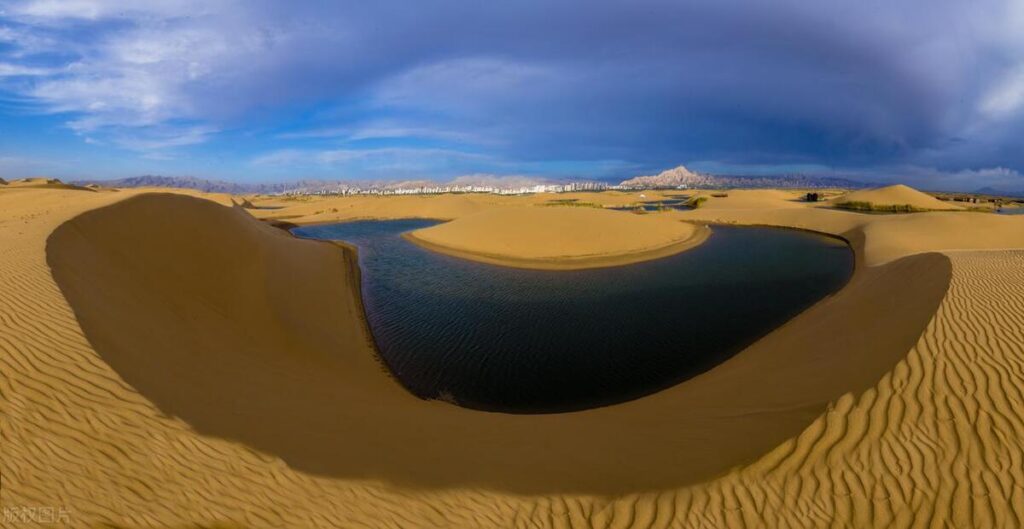
Deep in the desert of Hotan, Xinjiang, lush green rice paddies are quietly growing. Incredibly, the water source here doesn’t come from groundwater or rivers, but rather directly from the dry air. Using air-to-water technology, 10 tons of clean fresh water are produced daily, completely overturning the drought-stricken region’s dependence on rain for water. How does this cutting-edge technology create water from nothing? And how will it change the global water landscape?
1. From Science Fiction to Reality: The “Magic” Principle of Air-to-Water
The total amount of water vapor contained in the air is more than six times the volume of water in all the rivers on Earth, but efficiently capturing this “invisible water source” has always been a technical challenge. In recent years, Chinese research teams have achieved two core technological breakthroughs, allowing atmospheric water production to enter the industrial mass production stage:
- The “Molecular Catcher” Material Revolution:
The aluminum fumarate adsorption material developed by the University of Utah boasts a surface area equivalent to two football fields per gram, efficiently adsorbing water molecules at extremely low humidity levels. This metal-organic framework (MOF) material acts like a “sponge,” trapping water vapor and releasing liquid water through fuel combustion or solar heating. Each kilogram of the material can produce 5 liters of water per day. Kanghui Tianquan Company in China uses “polymerized nanomolecular materials” combined with non-equilibrium ion sterilization technology to directly convert vaporized water into weakly alkaline small-molecule water, achieving drinking water quality standards. - Wang Ruzhu’s team at Shanghai Jiao Tong University pioneered a synergistic “adsorption water extraction + heat pump refrigeration” system. This system utilizes solar energy
and radiant cooling technology to simultaneously extract water and lower the ambient temperature, reducing energy consumption by 70% compared to traditional condensation methods. Genesis Systems’ WaterCube also incorporates carbon capture capabilities, absorbing carbon dioxide during the water production process, doubling its environmental benefits.
2. Implementation scenario: Desert becomes granary, soldiers say goodbye to heavy loads
Atmospheric water technology has moved from the laboratory to the field, creating many impressive cases:
- Desert rice yields exceed 1 ton
per mu. The “Desert Plant Factory,” a collaboration between the Chinese Academy of Agricultural Sciences and Kanghui Tianquan, uses an air-to-water generator to capture greenhouse moisture day and night, producing an average of 10 tons of water per day. This system has successfully irrigated three rice seasons, with yields exceeding 1,000 kilograms per mu. The system also automatically regulates temperature and humidity, reducing pests and diseases, making it a “revolution in desert agriculture.” - Lightweight individual equipment:
A compact water-generating device funded by the US military is the size of a backpack and uses fuel combustion for rapid circulation. This eliminates the need for soldiers to carry large quantities of drinking water and allows them to obtain water on demand in extreme environments. This technology has been field-tested and has demonstrated performance exceeding that of bottled water. - Atmospheric water generation:
Brands like Gree and Haier are releasing household water generators with daily outputs of 20-50 liters, enough to meet a family’s drinking water needs. The Macau government has even made these devices a core part of its plastic reduction program, projecting a reduction of one million plastic bottles annually.
3. Trillion-dollar market explosion: Who is competing for the “right to create water”?
According to the “2025 China Atmospheric Water Generator Industry Report”, the current market size has exceeded 10 billion yuan, with an annual growth rate of over 15%. Driven by policy dividends, the industry has formed a three-legged pattern:
- The University of Utah’s patented military technology
is being rapidly adapted for civilian use after passing military verification. It is primarily used for rapid water extraction in high-humidity areas. - Environmental protection companies are making cross-border investments.
Kanghui Tianquan is collaborating with photovoltaic and wind power companies to build a distributed water production network with zero electricity dependency, targeting the rural and arid regions market. - Home appliance giants are launching a dimensionality reduction attack.
Midea and Gree, relying on their industrial chain advantages, have launched smart IoT models, which monitor water quality and output in real time through APP to seize the urban household market.
4. Controversy and the future: A real antidote or just a capital gimmick?
Despite its promising prospects, air-to-water technology still faces skepticism:
- Cost bottleneck : The initial investment in agricultural-grade equipment is as high as one million yuan, which restricts large-scale promotion;
- Energy dependence : Arid regions often lack electricity, and pure solar energy solutions are greatly affected by weather;
- Geological risk : Excessive extraction of atmospheric water could alter the local climate balance.
To this end, the industry is breaking through through three innovations:
- Material iteration : Dongjing Technology has developed super-hydrophobic cooling surface technology, which increases condensation efficiency by 3 times and reduces energy consumption per unit water production;
- Model innovation : Adopting the “equipment leasing + pay-per-water” model, farmers can access the system at zero cost;
- Eco-compensation : Equipment like WaterCube integrates carbon capture capabilities, producing water while simultaneously neutralizing environmental costs.