Hangzhou Zenius New Energy Co., Ltd.
-
+86 158-8822-2598









AWG Case Study: 2,000 L/day Bottled Water Plant — Making Source Water on Site
2,000 L
rated output per unit per day
4,000
500 ml bottles from one unit per day at rated output
24/7
continuous production decoupled from line hours
0 L
of source water trucked in from elsewhere
TL;DR — This is a photo-documented report from a customer’s bottled water site, not a modelled scenario. A bank of 2,000 L/day atmospheric water generators is installed outdoors along the plant wall — shaded, fenced and spaced for intake airflow — and the water they produce is held in food-grade buffer tanks before it reaches the filling line, where palletised glass bottles are waiting. Nothing about the project is unusual, which is the point: this is what a standard air-to-water bottling installation looks like once it is commissioned. Because this is a working commercial site, we publish the configuration and the engineering rather than the customer’s name, pricing or cost figures.
New to the category? Our atmospheric water generator guide explains how the machine condenses water, what it really produces in a given climate, and what a litre costs to run.
Why a bottler would make its own source water
Most bottling plants are built around a licence to abstract water from somewhere — a spring, a borehole, a municipal supply. Every one of those options carries a risk the bottler does not control: a aquifer that drops in a dry year, a municipal tariff that rises, a source whose chemistry drifts seasonally and forces the treatment train to be retuned.
An atmospheric water generator removes the source question entirely. The input is ambient air, available at the plant gate, and the output is consistently low in dissolved solids and free of the industrial and agricultural contaminants that groundwater increasingly carries. For a plant already running a treatment train, that translates into three practical advantages:
- Stable inlet quality. Condensate is repeatable, so downstream filtration and disinfection are sized once and stay predictable instead of chasing seasonal swings in the raw supply.
- No abstraction permit, no quota. The water is not drawn from a regulated body of water, which removes an entire category of permitting and renewal risk.
- Capacity grows in blocks. Adding units adds litres. There is no pipeline to lay, no new well to drill, and existing production keeps running while the extra capacity is installed.
Site layout — the generator bank sits outside
In the photograph below, the generators stand in a row along the outside of the plant building. Each unit sits under its own canopy. This is a deliberate choice rather than a convenience: keeping direct sun off the cabinet reduces heat load on the condenser, protects finishes, and gives technicians somewhere to work that is not an oven. The mesh fence is doing two jobs at once — it keeps unauthorised hands off electrical panels and it keeps the installation inside a defined, drainable compound.
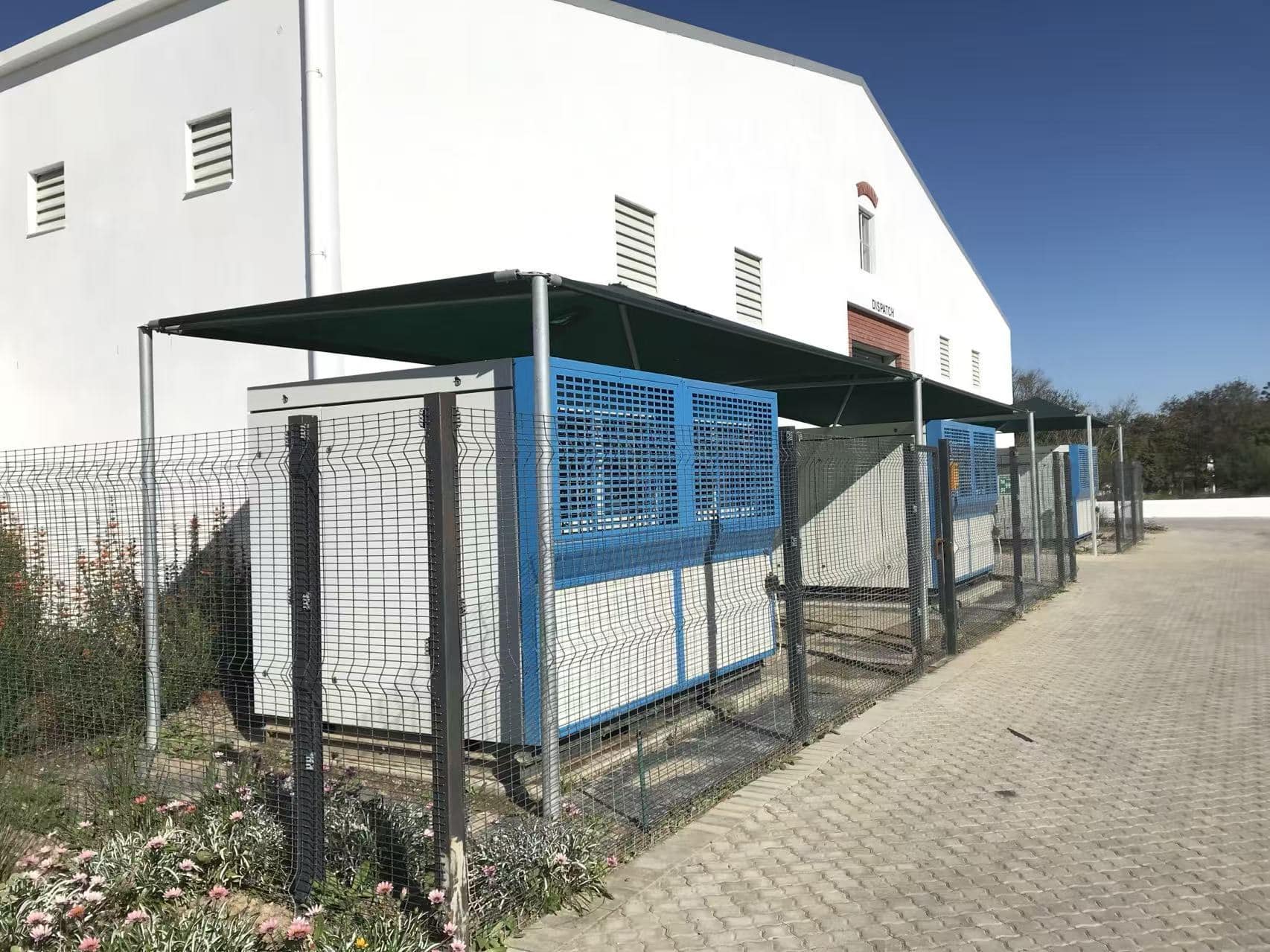
Three details decide whether an outdoor installation like this behaves for years:
- Airflow clearance. Generators move a lot of air. Crowding them together or boxing them in against a wall makes each unit recycle its own exhaust air and quietly starves its own output.
- Level, load-bearing base. A unit holding water is heavy, and a sloping slab puts standing stress on the frame and pipework.
- Drainage. Condensate production, filter flush and periodic sanitising all send water to a drain. Sizing that drain during layout is cheap; retrofitting it later is not.
Inside the plant — buffer storage and the filling line
The second photograph is inside the same plant. Generated water passes into food-grade buffer tanks, then to the treatment and filling side. In the background are pallets of empty glass bottles, wrapped and staged for the line — the usual preparation for a production run.

Buffer storage is what reconciles two different clocks. The generator bank produces steadily, day and night; the filler runs in batches with changeovers and cleaning cycles between formats. A properly sized tank allows production to accumulate overnight so every shift starts with a full reserve, and lets the plant keep filling during routine maintenance on individual units.
What 2,000 L/day means on the line
Capacity figures read abstractly until they are converted into finished goods. One unit rated at 2,000 L per day, running at rated output, fills approximately:
| Bottle format | Bottles per day, per unit | Typical use |
|---|---|---|
| 330 ml | ~6,000 | Single-serve retail, hospitality minibars |
| 500 ml | ~4,000 | Standard retail and food service |
| 1.5 L | ~1,330 | Household and office packs |
| 18.9 L (5 gal) | ~105 | Cooler bottles, route delivery |
These are conversions from rated output, not guarantees: real daily volume follows local humidity and temperature, and every plant loses some water to rinsing, cleaning and quality sampling. That is why we size from climate records and line duty cycle rather than from the nameplate number.
From condensate to bottle — where our scope ends and yours begins
Our scope covers making and treating the water up to the point it becomes a bottler’s feedstock. Downstream — filler, capper, labeller, packaging — stays with the plant.
- ZENIUS supplies: the generator bank, the pre-filtration and disinfection stages sized to the target water spec, controls and monitoring, and commissioning support on site.
- The bottler supplies: the filling line, cleanroom enclosure, bottle supply and everything relating to the finished product, including the microbiological release testing and labelling compliance for its market.
- Shared territory: the taste target. Because condensate is low in minerals, most brands add a remineralisation or blending step to hit a profile, whether that is very light or closer to a spring water. This is specified jointly.
Rated power, water connections and dimensional drawings for the 2,000 L/day class unit are listed on the A2000 commercial atmospheric water generator page.
Commissioning checklist for a bottling project
Every bottling installation we support runs through the same sequence before a single bottle is filled:
- Site survey. Record annual RH and temperature ranges, available floor or yard space, drainage, power supply and distance from generator bank to water room.
- Sizing. Convert required daily bottle count back into litres, then into unit count, using the worst production month rather than the best.
- Layout sign-off. Fix intake clearances, canopy coverage, drain runs and pipe routing before concrete is poured.
- Installation. Base preparation, unit placement, plumbing and electrical connection.
- Treatment configuration. Filtration, disinfection and any mineral dosing set against the brand’s water specification.
- Water validation. Independent laboratory sampling of finished water against the applicable bottled-water standard — arranged and owned by the bottler.
- Trial run. Production over several days, with output logged against actual humidity so the plant knows its real daily volume.
- Handover. Operator training on filter changes, sanitising and seasonal settings.
Who this configuration suits
- Regional bottlers whose existing source is seasonal, saline or subject to tightening abstraction rules.
- Hospitality groups that want their own-brand bottled water made on the property instead of trucked in — see our AWG solutions for hotels and resorts.
- New market entry where permitting a groundwater source would take longer than building the plant.
- Relief and contingency stockpiles that need packaged water capacity independent of the local supply.
- Institutions and government sites running their own bottling for staff, part of our wider government and military deployments.
Operating notes — what the crew actually does
Day to day, the job is routine. Filters are changed on condition rather than a fixed calendar date, because loading depends entirely on how dusty the site’s air is. Cabinets are kept shaded and their surroundings clear. Units are rotated so wear and cleaning downtime are spread across the bank. Output is logged so the plant knows its seasonal envelope after a year rather than guessing at it — and so any drop can be spotted early as a maintenance signal rather than a surprise shortage.
Frequently asked questions
Is water made from air safe to bottle and sell?
It can be, but permission to sell sits with the bottler, not with us. Water condensed from air starts very low in dissolved solids, so it is treated like any other low-mineral source: filtration, disinfection and, if the brand requires a mineral profile, remineralisation. The finished water then has to be validated by an accredited laboratory against the bottled-water standard that applies in the destination market. We supply the generating and treatment equipment and the documentation that supports that validation.
How much water will a 2,000 L/day unit actually produce?
Less or more than the nameplate, depending on relative humidity and ambient temperature. Rated capacity applies at rated conditions; output falls as air gets drier and cooler, and every system should be sized from site-specific RH and temperature records rather than from the brochure figure. Our atmospheric water generator guide shows measured output bands by climate.
Can the generators be installed outdoors, like the units in these photos?
Yes. This plant runs its generator bank outdoors. What makes that work is unglamorous: a level, load-bearing base, shade to keep direct sun off the cabinet, clearance around the air intake and discharge, a drain for condensate purge and cleaning water, and a lockable perimeter so only trained staff can reach the panels.
Why does a bottling plant need buffer tanks between the generators and the filler?
Because the two machines run on different clocks. An atmospheric water generator makes water continuously, around the clock, while a filler runs in batches with cleaning cycles and changeovers between bottle formats. Storage lets production accumulate at night so the line can start each shift with a full buffer.
Can an existing bottler add atmospheric water generation to a line that already runs?
Yes, and that is often the easiest version of the project. The generator bank ties into the existing treated-water loop as an additional source, so the filler, capper, labeller and packaging all stay as they are. The work sits upstream, in the water room and the yard.
Does water from air taste flat because it has no minerals?
Condensed water is low in minerals, which is why taste targets are set with a remineralisation or blending stage rather than assumed. Whether a brand wants a very light profile or a spring-style mineral balance is a product decision, and we configure the dosing step to hit it.
Related reading
- A2000 — 2,000 L/day commercial atmospheric water generator
- AWG for hotels and resorts
- AWG for government and military
- Atmospheric water generator pros and cons (honest 2026 guide)
- Certifications and compliance
- All ZENIUS case studies
Planning a bottling project? Tell us your target daily volume, bottle formats and climate data, and we will size the bank honestly — including saying no if your site is better served by another source. Request a feasibility assessment →