Hangzhou Zenius New Energy Co., Ltd.
-
+86 158-8822-2598









Point-of-Use Water Dispensers: UF vs RO vs UV — How to Choose
What a point-of-use water dispenser is asked to solve
A point of use water dispenser is plumbed into the building supply, treats water where it is drawn, and serves it hot, cold, or at room temperature. It replaces bottled deliveries in offices, clinics, staff canteens, and hotel floors, along with the bottle handling. Buyers are distributors, facility managers ending a bottle contract, or specifiers writing the plumbing and electrical schedule. The common mistake is choosing filtration before testing the feed water.
The second mistake is sizing from headcount rather than peak demand. Tanks here hold single-digit liters and refill while being drawn from, so a generous-looking unit can run cold mid-break.
- What UF, RO, and UV each remove, and what each costs you
- How to read tank volumes against recovery rates
- The plumbing, electrical, hygiene, and safety items on a specification
UF, RO and UV: what each one removes and what it costs you
Ultrafiltration is a physical barrier holding back suspended solids, turbidity, and microorganisms while dissolved minerals pass, so taste stays close to the supply. Reverse osmosis also reduces dissolved solids, suiting hard or high-TDS water, but it needs driving pressure and a concentrate drain, and produces more slowly. UV neither filters nor softens.
The K6 shows the fork: a 4-stage UF chain (PP + CTO + UF + T33) or a 4-stage RO chain (PP + CTO + RO + T33). The UF version carries a 3.7 L cold tank, the RO version 6.5 L, because slower output needs buffer. Hot side: 1.5 or 2 L at 90 °C or above, 5 L/H from 500 W.
UV placement is the second decision. In-tank treatment, as on the T2, addresses stored water and wetted tank surfaces where water sits overnight. A lamp in the flow path, as on the T-K6, treats water as it is dispensed; that unit runs PPF, pre-carbon, UF, post-carbon, and UV.
Point-of-use dispensers and atmospheric water generators: complements, not substitutes
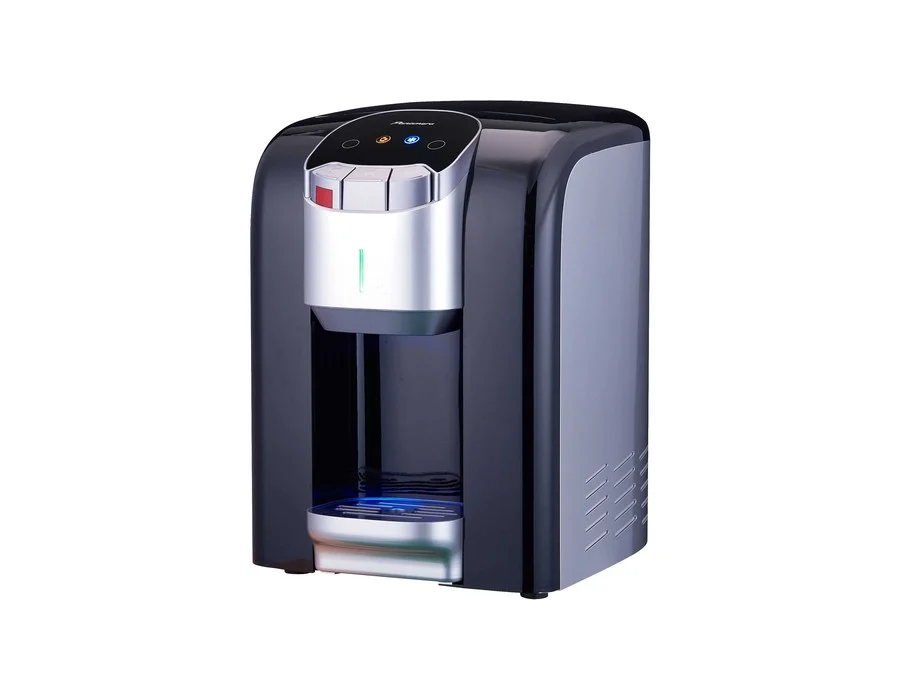
A point-of-use dispenser conditions water that already exists; an atmospheric water generator makes water from air humidity. The two are paired rather than compared; see what an atmospheric water generator is. The Panamara floor-standing dispenser sits on the point-of-use side: it takes a supply connection and serves cold, hot, extra-hot, and ambient water by piano-key selection.
| Model | Typical site | Key figures | Trade-off |
|---|---|---|---|
| T2 | Small offices | Hot 1.5 or 2 L, 90 °C or above, 5 L/H, 500 W; cold 2 L/H, 80–98 W; cold tank 3.7 L or 6.5 L | UF or RO fixed at order |
| K6 | Either chain | 4-stage UF or RO; hot 1.5 or 2 L, 5 L/H; cold 2 L/H, 80–98 W; 43×30×48 cm or 43×30×113 cm | Cartridge list differs |
| T-K6 | In-line UV | PPF + pre-carbon + UF + post-carbon + UV; cold 3.5 L, hot 1.5 L; cooling 100 W, heating 1200 W + 65 W | UF only |
| Noam 2 | RO with UV | Cold 7.5 L, hot 1.5 L with bottom heat at about 90 °C; cold 1.8 L/H, hot 6.5 L/H; hot button lock | Slowest cold recovery |
| Noam 3 | Hot water priority | Hot 6 L, cold 6 L; hot 6.8 L/H, cold 1.8 L/H; child lock; dispenses without power | Cold stays at 1.8 L/H |
| AQ-36L | Mains, with alarms | Hot 1.2 L (1.8 or 4 L), 90 °C or above, 5 L/H or more; cold 3.8 L, 2 L/H or more; heating 400 W (675 or 800 W) | Tank and heater chosen together |
| Panamara | Reception areas | Hot 90 °C or above, 5 L/H; cold 3.7 L, 2 L/H, 5–10 °C; piano-key cold, hot, extra hot, ambient; 25 cm clearance | Needs a supply connection |
Read volumes against the liters-per-hour figures, never alone. Cold is the constraint at 1.8 to 2 L/H.
Six steps to specify the right unit
- Step 1 — Test the feed water. Measure TDS, hardness, and turbidity at the tap first. UF keeps minerals; RO suits hard or high-TDS water, but needs inlet pressure and a concentrate drain.
- Step 2 — Size the hot side from the peak window. Hot tanks run 1.2 L to 6 L at 5 to 6.8 L/H, 90 °C or above. On the AQ-36L: 1.2 L standard with 1.8 L or 4 L, heating 400 W, 675 W, or 800 W.
- Step 3 — Size the cold side the same way. Cold tanks run 3.5 L to 7.5 L, but output stays at 1.8 to 2 L/H at 5–10 °C. The larger RO tank buffers a slower rate.
- Step 4 — Choose mains connection or bottled supply. The AQ-36L connects directly to municipal water, with anti-dry-fire protection, overflow and fault alarms, and optional microcomputer control. Bottled units keep the bottle handling.
- Step 5 — Fix the electrical picture early. Cooling draws 80 to 100 W; heating 400 W to 1200 W plus 65 W auxiliary. Confirm 220–240 V at 50 Hz or 110–127 V at 60 Hz per unit.
- Step 6 — Settle who stocks the cartridges. UF and RO configurations do not share a cartridge list. Set replacement by water quality and dispensed volume.
Installation, hygiene and day-to-day operation
Plumbed in, a dispenser is a permanent fixture: a dedicated shutoff valve, an unstrained supply line, and on RO configurations a gravity drain for the concentrate. Confirm static inlet pressure against the membrane requirement before ordering. Give each unit its own circuit and keep the rear air path clear.
Hygiene work is contact surfaces and cartridges. Clean the drip tray, the dispensing recess, and the faucet spouts routinely. Cartridge changes follow water quality and dispensed volume rather than a date.
Three safety features matter in specific settings. Where children reach the panel, a hot-water lock is required: the Noam 2 locks the hot button, the AQ-36L needs its unlock key held for a second. Where supply is intermittent, anti-dry-fire protection keeps the heater off an empty tank. Where outages are common, Noam 2 and the Noam 3 dispense by hand.
For seasonal shutdown, isolate the supply, drain the tanks, and leave the tray dry. On RO units, close the feed so the concentrate line does not hold water.
What to settle before an OEM or ODM order
- Voltage, frequency and plug. State the destination country: 220–240 V at 50 Hz or 110–127 V at 60 Hz, with the matching plug. Elements are built to that voltage.
- Configuration lock. UF or RO, tank sizes, and heater wattage are set at build time. Write them into the order line.
- Housing, color and panel finish. Cabinets come with all-plastic shells in different colors, SUS304 side panels with a painted front, and multi-color options.
- Branding and nameplate. Logo placement, model designation, rating label language, and private-label marking belong on the drawing before production.
- Packing and container loading. Confirm carton and palletizing for full containers. A floor unit in the 33×30×99 cm class loads 200 per 20 ft container and 380 per 40 ft.
- Delivery documentation. Ask for the manual in the destination language, the wiring diagram, the exploded view with part numbers, and a spare parts list.
Point-of-use water dispensers — frequently asked questions
Should I specify UF or RO for a point-of-use water dispenser?
Start with the feed water. If dissolved solids are low and the complaint is taste, chlorine, or turbidity, UF with carbon stages is enough. Choose RO where TDS or hardness is high, and budget for inlet pressure and a concentrate drain.
If the unit has UV, do I still need filtration?
Yes. UV inactivates microorganisms in the water it reaches, but removes no sediment, no chlorine, and no dissolved solids, and works poorly in turbid water. The lamp sits after the filters or inside the tank, so cartridges still need replacing.
What changes when a bottled-water cooler is replaced with a mains-connected unit?
Three things change: plumbing, power, and responsibility. The unit needs a permanent connection to the municipal supply with a shutoff valve and, on RO models, a concentrate drain, plus a circuit for the heater. In exchange you stop ordering and storing bottles.
How do I size the hot and cold tanks for an office?
Work from the peak window, not the headcount. Hot tanks run 1.2 L to 6 L at 5 to 6.8 L/H, and cold tanks 3.5 L to 7.5 L at 1.8 to 2 L/H. The tank covers the first cups; the rate decides recovery.
Will the dispenser still work during a power outage?
Only the mechanical parts. Models with a mechanical push faucet, such as Noam 2 and Noam 3, still dispense when power is lost, because the valve is hand operated. Heating, cooling, and UV stop. Where continuity matters, specify a mechanical faucet; stored hot water will cool.
How often should the filters and the UV lamp be changed?
Tie it to water quality and dispensed volume, not the calendar. Two identical units on different supplies need cartridges at different intervals. Watch for falling flow, a taste change, or the filter-life indicator. The UV lamp gives no flow signal, so track its operating hours.