Hangzhou Zenius New Energy Co., Ltd.
-
+86 158-8822-2598











Philippines El Niño 2026–2027: Why the Government Is Buying Atmospheric Water Generators
Quick Answer: The Philippines is heading into a strong El Niño that PAGASA projects will put up to 84 provinces into drought by March 2027. On 28 September 2026 the Department of Social Welfare and Development (DSWD) inaugurated the country’s first government-funded atmospheric water generator (AWG) in Cawayan, Masbate — a PHP 19 million, solar-hybrid system serving 836 households whose groundwater is too salty to drink. An atmospheric water generator produces drinking water from humidity in the air, so it works even when wells, rivers and rainfall fail. For distributors and project buyers, this is a clear signal: AWG has moved from niche technology to mainstream government procurement.
An atmospheric water generator (AWG) is a machine that extracts moisture from ambient air and condenses it into clean, potable water. That simple definition is suddenly front-page news in the Philippines, where the national weather bureau expects the worst drought in years — and where the government has just commissioned its first community-scale AWG. This article explains the official El Niño outlook, what the new DSWD installation actually does, and what it means for B2B buyers, distributors and project developers in the region.
1. What PAGASA’s 2026–2027 Outlook Says
The Philippine Atmospheric, Geophysical and Astronomical Services Administration (PAGASA) issued its climate outlook for October 2026 to March 2027 on 7 October 2026. Three findings stand out:
- A strong El Niño is already established in the tropical Pacific and may reach a very strong state by the end of 2026, persisting through the first half of 2027.
- The southwest monsoon (habagat) has ended, removing the main seasonal rainfall source for western Luzon and the Visayas.
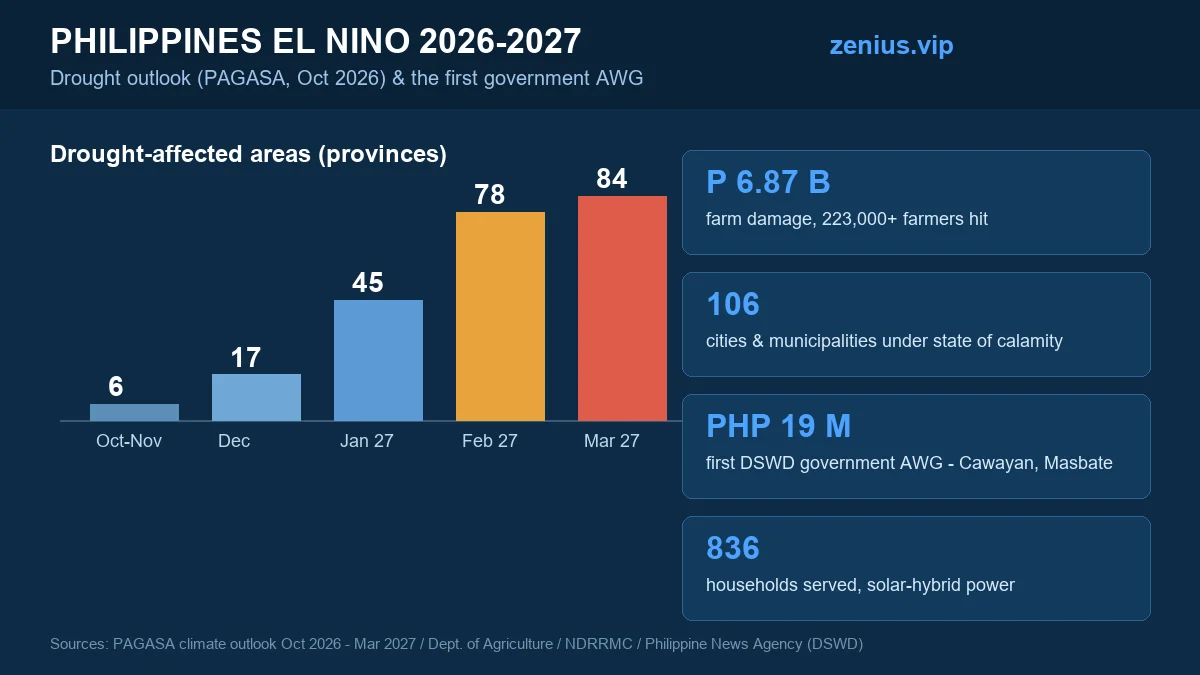
- The number of drought-affected provinces rises month by month, peaking at 84 in March 2027.
PAGASA classifies an area as being in drought after three consecutive months of way-below-normal rainfall. Its month-by-month projection:
| Period | Projected drought-affected areas | Rainfall deficit |
|---|---|---|
| October–November 2026 | 6 provinces (Luzon and Visayas) | 20–60% below normal |
| December 2026 | 17 areas | More than 60% below normal |
| January 2027 | 45 areas | Way-below-normal across most of the country |
| February 2027 | 78 areas | Nearly nationwide |
| March 2027 | 84 areas | Nearly nationwide |
In other words, the deficit is compounding: below-normal rainfall in October becomes way-below-normal from November–December, and by January to March nearly every part of the archipelago is affected.
2. The Damage Already on the Ground
This is not a forecast-only story. As of late September 2026, the Department of Agriculture reported about PHP 6.87 billion (roughly USD 120 million) in agricultural damage and production losses, affecting 223,214 farmers and more than 249,000 hectares across 14 regions. Rice, corn, cassava, high-value crops, livestock and poultry have all been hit.
The National Disaster Risk Reduction and Management Council counts 106 cities and municipalities under a state of calamity, with five provinces — Isabela, Cagayan, Camarines Norte, Dinagat Islands and Agusan del Sur — issuing provincial declarations. Government agencies have released nearly PHP 10.96 billion in assistance, including crop insurance and irrigation support.
Water is the tightest constraint. In many affected communities, deep wells are brackish, surface sources dry up, and hauling water by boat or truck becomes the default — expensive and unreliable when rough seas or damaged roads interrupt supply.
3. Cawayan, Masbate: The First Government-Funded AWG
Against this backdrop, the DSWD’s move is what makes the technology newsworthy. On 28 September 2026, DSWD Secretary Rex Gatchalian led the inauguration of the country’s first Atmospheric Water Generator funded under the KALAHI-CIDSS program, in Barangay Gilotongan, Cawayan, Masbate.
| Item | Detail |
|---|---|
| Project cost | PHP 19 million (KALAHI-CIDSS grant plus local government counterpart funding) |
| Power source | Hybrid, including solar power |
| Households served | 836 households, including the Gilotongan Water and Sanitation Association (GIWASA) |
| Why an AWG | Deep-well water on Gilotongan Island is salty and unsuitable for drinking; the community previously relied on water hauled from other barangays or the mainland |
| Status | Construction began in late 2025; inaugurated 28 September 2026 |
DSWD Bicol Director Norman Laurio said the system “provides an alternative source of potable water by extracting moisture from the air and converting it into water for community use,” helping mitigate El Niño’s effects. For an island community, the AWG removes the dependency on boat-delivered water when rough seas cut off transport. DSWD has signalled that the project is a pilot: the department is studying replication in other water-scarce communities as part of its Risk Resiliency Program, alongside projects such as LAWA (farm reservoirs) and BINHI (communal gardens).
The strategic message from Manila is hard to miss. An island nation of more than 7,600 islands cannot solve a rainfall failure by drilling deeper wells. Air is the one water source that never runs dry — the atmosphere over the Philippines holds moisture even in the driest months.
4. Why AWG Fits El Niño Response
Atmospheric water generation works everywhere the air holds enough moisture — and El Niño makes it hotter, not drier, in absolute humidity terms along the coasts. The technology has four properties that map directly onto drought-response requirements:
- Independent of rainfall and groundwater. No wells, no rivers, no desalination intake. The feedstock is ambient air.
- Point-of-use production. Water is made where it is consumed, eliminating hauling costs and transport interruptions.
- Solar-hybrid compatibility. Like the Masbate unit, AWG systems pair naturally with solar power in off-grid island settings.
- Scalable from household to city. Commercial machines produce hundreds of litres per day; containerized systems reach 10,000 L/day and above.
Typical performance figures for modern commercial AWG equipment: at 30°C and 80% relative humidity, about 30 litres of water per day per kW of input power; commercial-scale units operate at roughly 0.25–0.35 kWh per litre of produced water. The Philippines’ coastal climate — warm and humid year-round even during El Niño — sits squarely in the efficient operating envelope. Water output varies with temperature and humidity, so product documents and market requirements must be checked for the selected model and destination.
5. What It Means for B2B Buyers and Distributors
When a national government funds its first AWG and names it a model for replication, procurement follows. For companies watching the Philippine market, three practical takeaways:
- Government and NGO demand is opening. KALAHI-CIDSS is a community-driven development program that funds hundreds of sub-projects per year; a proven AWG category entry gives local government units a template to copy.
- Entry is realistic for mid-size players. ZENIUS offers AWG systems from 10 to 10,000 litres per day, with OEM/ODM programs available from as few as 1 unit — a low barrier for a distributor wanting to trial the municipal and resort market.
- Specification matters more than price. Buyers should compare energy per litre (kWh/L), operating envelope (temperature and humidity), filtration stages and compliance documentation for the destination market.
ZENIUS is an AWG brand manufacturer headquartered in Hangzhou, China, exporting to more than 30 countries. Our branded products ship to distributors, importers and project buyers worldwide. Whether you need a pilot unit for an island barangay or containerized systems for a resort development, the sizing logic is the same: match daily water demand to the local humidity profile, then choose the energy source.
6. Frequently Asked Questions
How much water can an atmospheric water generator produce in the Philippines?
A commercial AWG produces roughly 30 litres per day per kW of input power at 30°C and 80% relative humidity, a common condition in the Philippine coastal climate. Actual output varies with temperature and humidity, so the model and destination should be checked against product documents.
Why did DSWD choose Cawayan, Masbate for the first AWG?
Gilotongan Island’s deep-well water is salty and unfit for drinking, and residents previously depended on water transported from the mainland. An AWG produces water locally from the air, cutting transport costs and keeping supply available when rough seas interrupt travel.
Does AWG still work during El Niño?
Yes. El Niño reduces rainfall but raises temperatures; absolute humidity along tropical coasts remains high. AWG output follows the moisture content of the air rather than rainfall or groundwater levels, which is why it fits drought response.
What is the minimum order for AWG OEM projects?
ZENIUS offers OEM/ODM cooperation starting from 1 unit, covering systems from 10 to 10,000 litres per day. This allows distributors and project developers to start with a pilot batch before scaling.
See Also
- Atmospheric Water Generators in Southeast Asia: Market Guide
- Atmospheric Water Generator vs Desalination
- Non-Electric Atmospheric Water Generators
- Atmospheric Water Generators for Agriculture
- ZENIUS AWG Products | Contact Us
Sources: PAGASA climate outlook (7 October 2026); Department of Agriculture damage reports; NDRRMC; Philippine News Agency, “DSWD P19-M potable water solution benefits 836 households in Masbate”; Manila Bulletin; GMA News.
