Hangzhou Zenius New Energy Co., Ltd.
-
+86 158-8822-2598











El Niño Emergency Water Supply in the Philippines: A1000 + Solar PV + Battery Storage + Utility Power for 24-Hour Water Production
Plan summary: For emergency water supply preparedness during El Niño in the Philippines, at sites with an existing utility connection and a target of 24-hour A1000 operation, the recommended approach is ‘solar PV first + utility power to cover shortfalls + battery storage for outage backup,’ rather than a fully off-grid configuration. Using 650W modules measuring 2384 × 1303mm as an example, a budgeting starting point is 100 solar panels (65kWp) + 150kWh of lithium iron phosphate battery storage; to cover an outage of approximately 12 hours, storage can be increased to 250kWh. These figures do not constitute a finalized equipment specification, a guarantee of uninterrupted power throughout the year or a fixed water output guarantee.
1. El Niño Emergency Water Supply: Applications and Capability Limits
The Philippine weather agency PAGASA notes that El Niño may increase the risk of below-normal rainfall, drought and dry spells in some areas, while typhoons and other weather systems may still bring heavy rainfall. Emergency water supply planning should therefore address water shortages, power outages, strong winds, drainage and equipment maintenance together; El Niño must not be interpreted as continuous sunshine.
Subject to a site assessment, the A1000 can serve as a supplementary water source for community drinking water points, schools, camps or other priority water-use locations. Drought or lower air humidity may also reduce atmospheric water production; it must not be promoted as an unlimited, weather-independent water source, nor used without verification as a replacement for all domestic or agricultural water needs of an entire community.
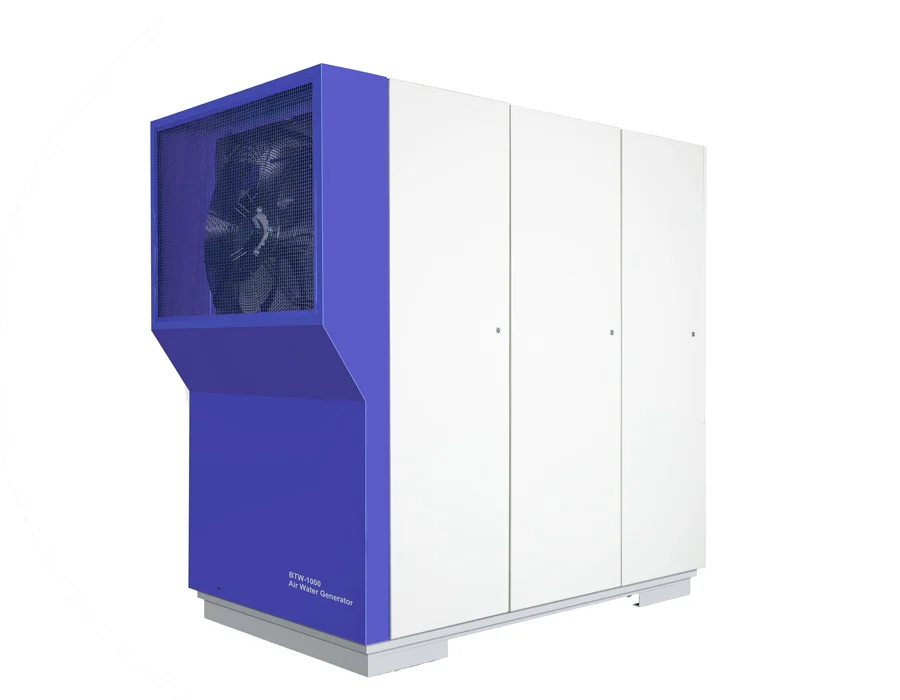
2. Electricity for 24-Hour Operation: Utility Power Covers Normal Shortfalls
The A1000’s documented input power is 12.3kW; continuous operation at this power for 24 hours would consume 295.2kWh/day for the main unit. This plan provisionally budgets 13kW and 312kWh/day, with the additional 0.7kW reserved only as an allowance for auxiliary equipment. Actual consumption by pumps, battery storage air conditioning, controllers and other auxiliaries must be measured and totaled. The documented power is not a verified all-day average; on-site electricity meter records can support subsequent optimization.
- Daytime: solar PV supplies the main unit first, with surplus power charging the battery under a strategy that preserves an emergency state of charge (SOC); unneeded generation is curtailed, or an appropriate grid-connected arrangement is used after obtaining local approval.
- Nighttime and cloudy or rainy conditions: utility power normally covers the shortfall; there is no need to shift the entire night’s electricity demand to the battery.
- Power outages: isolate from the utility grid and use a PV-compatible, grid-forming battery storage system to support critical loads. Ordinary grid-tied inverters cannot automatically continue supplying power during an outage.
- Water storage: store produced water in a sanitary tank to buffer short interruptions in water production; a tank cannot increase the main unit’s daily water production capacity.

3. How Many 650W Solar Panels Are Needed?
Solar resources vary across Philippine islands, cities and seasons. Energypedia’s introduction to photovoltaic project development in the Philippines cites a resource overview of approximately 4.5–5.5kWh/m²/day, which cannot be directly treated as a guarantee for every site. This budget uses 4.0 peak sun hours and an 80% effective factor from PV generation to the power supply bus to compare configurations; these are not year-round minimum values for the Philippines. This factor excludes subsequent losses from routing energy through the battery; orientation, shading, temperature, curtailment and equipment self-consumption must also be checked in practice.
Estimated daily energy = number of modules × 0.65kWp × 4.0 hours × 0.80.
| Option | PV capacity | Budgeted daily generation at the bus | Relative to the 312kWh daily load | Net module area |
|---|---|---|---|---|
| 80 panels | 52kWp | 166.4kWh | Theoretical energy share of approximately 53% | 248.5m² |
| 100 panels, budgeting starting point | 65kWp | 208.0kWh | Theoretical energy share of approximately 67% | 310.6m² |
| 120 panels | 78kWp | 249.6kWh | Theoretical energy share of approximately 80% | 372.8m² |
The table compares total energy quantities, not actual self-consumption rates, electricity bill savings percentages or guaranteed solar coverage. With the 100-panel option, even if all generation is effectively used and subsequent losses are ignored, utility supply would still be at least approximately 104kWh/day; utility consumption would be higher if midday solar surplus, a full battery or reserved backup capacity prevents sufficient energy shifting. Without other daytime loads, an hourly simulation should be performed for 80–120 panels to avoid substantial curtailment simply to pursue greater installed capacity.
Each module has an area of 2.384 × 1.303 = 3.106352m². For 100 panels, the net area is 310.6m², with approximately 405–500m² provisionally allowed for budgeting; for 120 panels, the net area is 372.8m², with approximately 485–600m² provisionally allowed. These allowances are estimated at approximately 1.3–1.6 times the net area and are not a universal layout standard; fire access routes, typhoon wind resistance, structural load capacity and maintenance setbacks require site-specific design.
4. With Utility Power Available, Size the Battery for Outage Duration
This plan uses battery storage primarily for outage backup and no longer assumes that a 300kWh battery is needed to cover normal overnight consumption. The budgeting assumptions are 90% depth of discharge, 94% battery-to-AC discharge efficiency and 90% remaining capacity:
Required nominal capacity = 13kW × backup hours ÷ (0.90 × 0.94 × 0.90).
| Outage backup target with no solar PV | Calculated minimum nominal capacity | Configuration comparison reference |
|---|---|---|
| 4 hours | Approximately 68.3kWh | 80–100kWh |
| 8 hours | Approximately 136.6kWh | 150kWh, budgeting starting point |
| 12 hours | Approximately 204.9kWh | 250kWh |
| 24 hours | Approximately 409.8kWh | 450–500kWh |
Under these assumptions, 150kWh provides approximately 114.2kWh of AC energy, supporting a 13kW load for approximately 8.8 hours; 250kWh provides approximately 14.6 hours. Both durations start from a full charge with the entire specified SOC window available; a lower starting SOC, additional loads or greater degradation will shorten them. The 90% remaining capacity is only a budgeting point, not an end-of-life guarantee. Solar PV available during an outage may extend operation, but backup capacity does not depend on sunshine being available.
The control strategy should preserve an emergency SOC and explicitly distinguish capacity used for routine energy shifting from capacity reserved for outages. If the battery is emptied every night, a full 8 hours of backup cannot also be promised for an outage early the following morning. If emergency energy must be available at any time, consider additional SOC headroom or separately reserved capacity.

5. Electrical Compatibility in the Philippines: Verify 60Hz and Three-Phase Voltage First
Meralco technical documentation lists 60Hz and supply levels including 400/230V and 460V, but conditions within its service area must not be assumed to apply to every site nationwide. Existing A1000 documentation covers different supply configurations: 380–400V/50Hz or 440–460V/60Hz. If the site has 400V/60Hz power, compatibility with either existing version cannot simply be assumed; the supplier must confirm the appropriate model or solution in writing. An ordinary transformer cannot change frequency, and an arbitrary frequency conversion device must not be regarded as a guarantee of compatibility for the complete unit.
- Confirm that usable three-phase utility power is available, not merely a single-phase residential supply; capacity must cover the main unit, auxiliaries and battery recharging simultaneously.
- Three-phase battery storage power conversion systems (PCS) or hybrid systems in the 30–50kW class can be considered for comparison. Continuous power, kVA, compressor starting current and overload duration must each be checked; a fixed multiplier does not guarantee successful starting.
- A module DC capacity of 65–78kWp does not mean that all modules can be connected to a single 30kW inverter. Check PV input limits, MPPT current, charging power and off-grid compatibility separately.
- Outage transfer requires compliant isolation, anti-islanding, grounding and protection; seamless transfer must be verified against system performance and the main unit’s allowable interruption time. Otherwise, design for controlled shutdown and delayed restart rather than claiming zero interruption.
- Grid connection, zero export or power export must be checked against utility requirements by a qualified local installer; this article makes no commitment regarding export permission or revenue.
6. Emergency Water Output and Storage Tanks Require Separate Acceptance Checks
The A1000 has a capacity class of 1000L/day, with reference-condition production of 965L/24h (30°C, 80%RH); this is not a guarantee under all Philippine environmental conditions. Determine usable daily production from minimum dry-season humidity, temperature, ventilation and continuous operation records. Power supply supporting 24-hour operation does not mean a fixed output of 1000L every day.
Select the water storage tank according to actual daily emergency demand, planned buffer duration, cleaning and disinfection requirements, and turnover conditions. For example, at actual consumption of 1000L/day, a 2-day buffer requires 2000L of net usable water, but whether it can be replenished in time depends on measured production. Drinking water use requires water quality verification and sanitary management; a TDS reading alone cannot demonstrate drinking safety. Retaining an external emergency water source and a distribution contingency plan is also recommended.
7. Compare Two Configurations First
| Combination | Solar PV | Battery storage | Purpose |
|---|---|---|---|
| Utility-supported emergency option | 100 × 650W panels / 65kWp | 150kWh | Utility power supports day-and-night operation, with approximately 8.8h of no-solar backup from a full charge |
| Extended outage backup option | 100–120 panels / 65–78kWp | 250kWh | Approximately 14.6h of no-solar backup from a full charge; further checks are needed on generation utilization and recharge recovery time |
These are comparison options proposed on the basis that utility power is available; they do not represent backup durations already specified by the user. If outages are very rare at the site, battery capacity may be reduced further; if outages frequently last 24 hours, increase storage or add a generator and reassess recharging capability. The previous fully off-grid concept of 200–220 solar panels and 300kWh of battery storage is no longer the default recommendation for this project, although larger configurations can still be evaluated separately for higher solar coverage or longer autonomy targets.
Frequently Asked Questions
Are more than 200 solar panels still needed if utility power is available?
Not necessarily. Utility power can cover nighttime and cloudy or rainy shortfalls. Solar PV capacity should be determined by the target energy displacement, available area and hourly self-consumption capability. This plan starts by comparing 100 × 650W modules rather than pursuing unverified year-round off-grid operation.
Can a 150kWh battery power the A1000 for 24 hours?
No. At a 13kW load and under this article’s capacity and efficiency assumptions, no-solar backup from a full charge is approximately 8.8 hours; all-day operation requires continued supply from utility power or solar PV.
Does El Niño drought necessarily make atmospheric water generation more suitable?
No such guarantee can be made. Demand arising from water shortages may increase, but lower relative humidity may also reduce water production. First test usable water output and electricity consumption under the site’s dry-season temperature and humidity conditions, then determine water supply commitments.
Next Steps: Site Confirmation
The required information includes the specific Philippine city, utility company, on-site three-phase voltage and frequency, available electrical capacity, typical outage duration, installation area, dry-season temperature and humidity, and measured A1000 power consumption. Determining module series and parallel counts requires complete Voc, Vmp, Isc, Imp and temperature coefficient data; 650W ratings and dimensions alone are insufficient.
Sources: PAGASA weather and El Niño advisories; Introduction to photovoltaic development resources in the Philippines; Meralco supply voltage information; Meralco power quality technical documentation; A1000 product specifications. All efficiency values, auxiliary power allowances and area allowances are planning assumptions, not findings from on-site measurements.
Ask about an El Niño emergency water supply plan · Learn about atmospheric water generator electricity consumption