Hangzhou Zenius New Energy Co., Ltd.
-
+86 158-8822-2598


AWG vs Rainwater Harvesting: Which Off-Grid Water System Is Right for You? (2026)
If you’re evaluating off-grid or sustainable drinking water for a home, school, or facility, two technologies dominate the conversation: atmospheric water generators (AWGs), which pull moisture from the air, and rainwater harvesting systems, which collect and filter rainfall from your roof. Both are zero-municipal, both are sustainable, both reduce plastic waste. They are not interchangeable, though — each shines in different climates, sites, and use cases, and the wrong choice is expensive to fix after installation.
This guide walks through how each system works, what it costs, where each one wins, and how to make a confident decision based on your climate, water demand, and budget. It builds on our atmospheric water generator sizing guide and atmospheric water generator cost per litre for the AWG side, and references the same depth of analysis for the rainwater side.
1. TL;DR: The 30-Second Decision Tree
Use this decision tree first, then read the full guide to verify.
| If your site has… | Choose | Why |
|---|---|---|
| Rainfall >600 mm/year and a usable roof | Rainwater harvesting | Cheaper per litre; passive; no electricity |
| Rainfall <300 mm/year (desert, semi-arid) | AWG | Rain is too scarce and unreliable to depend on |
| Rainfall 300–600 mm/year with humidity >60% | Both, in series | Rainwater for non-drinking; AWG for drinking |
| Strictest drinking-water quality requirement | AWG with multi-stage filtration | On-site generation + UV gives the most consistent water quality |
| Lowest upfront cost | Rainwater harvesting | $500–$3,000 vs $4,000–$25,000 for AWG |
| Off-grid with no existing roof catchment | AWG | Rainwater needs a roof; AWG only needs electricity |
| Compliance with rainwater restrictions (some municipalities ban potable rainwater) | AWG | No regulatory grey zone |
The rest of this article shows the reasoning behind this table, with hard numbers, climate data, and three deployment case studies.
2. How Each System Works
2.1 Rainwater Harvesting
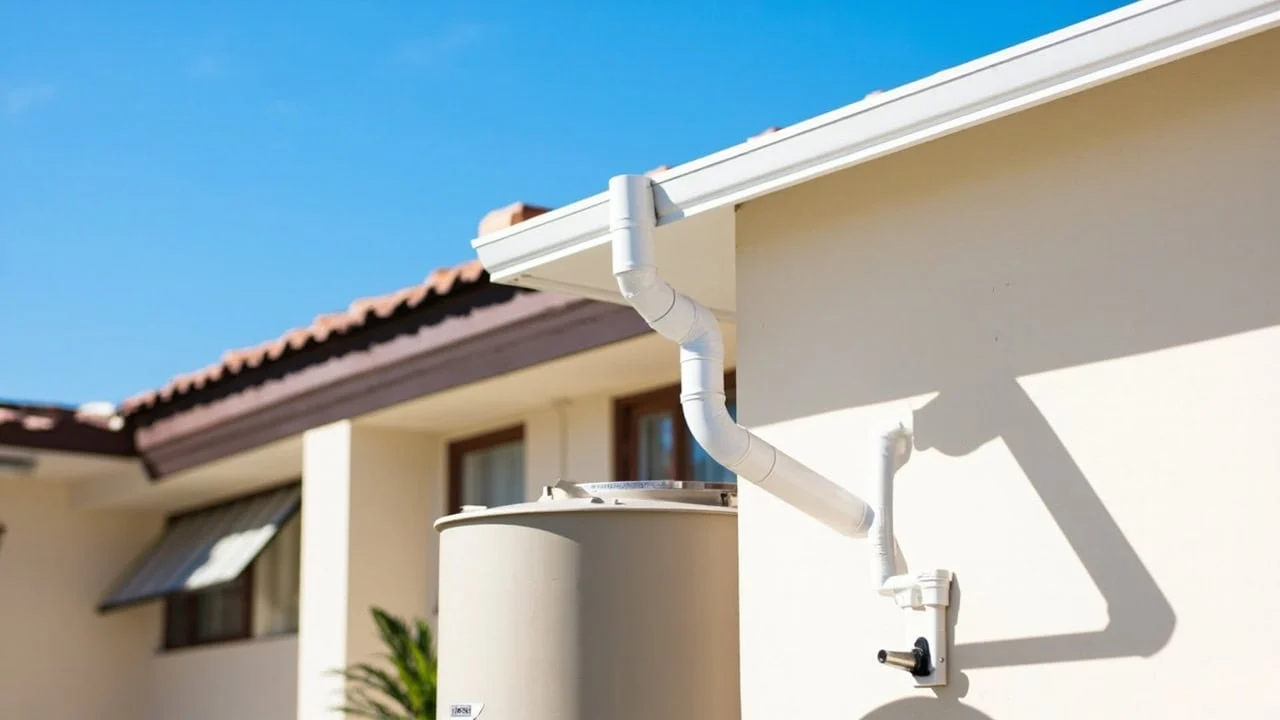
A rainwater harvesting system has four stages:
- Catchment — the roof of the building collects rain. Metal, tile, and slate roofs work best; asphalt shingle roofs leach chemicals and are usually excluded for potable use.
- Conveyance — gutters and downspouts channel the water to a storage tank. First-flush diverters dump the first few litres (which carry dust and bird droppings) to waste.
- Storage — the tank holds the water until use. Common sizes are 1,000–20,000 L for residential and small commercial; underground cisterns are common in arid regions.
- Treatment — for potable use, the water passes through sediment filtration, carbon filtration, and usually UV disinfection.
The whole system is passive during collection — no electricity is needed until the treatment stage, and even then a small UV lamp runs on 10–40 watts. A well-designed system in a wet climate can supply 50–80% of a household’s total water demand (drinking + non-drinking).
2.2 Atmospheric Water Generator (AWG)
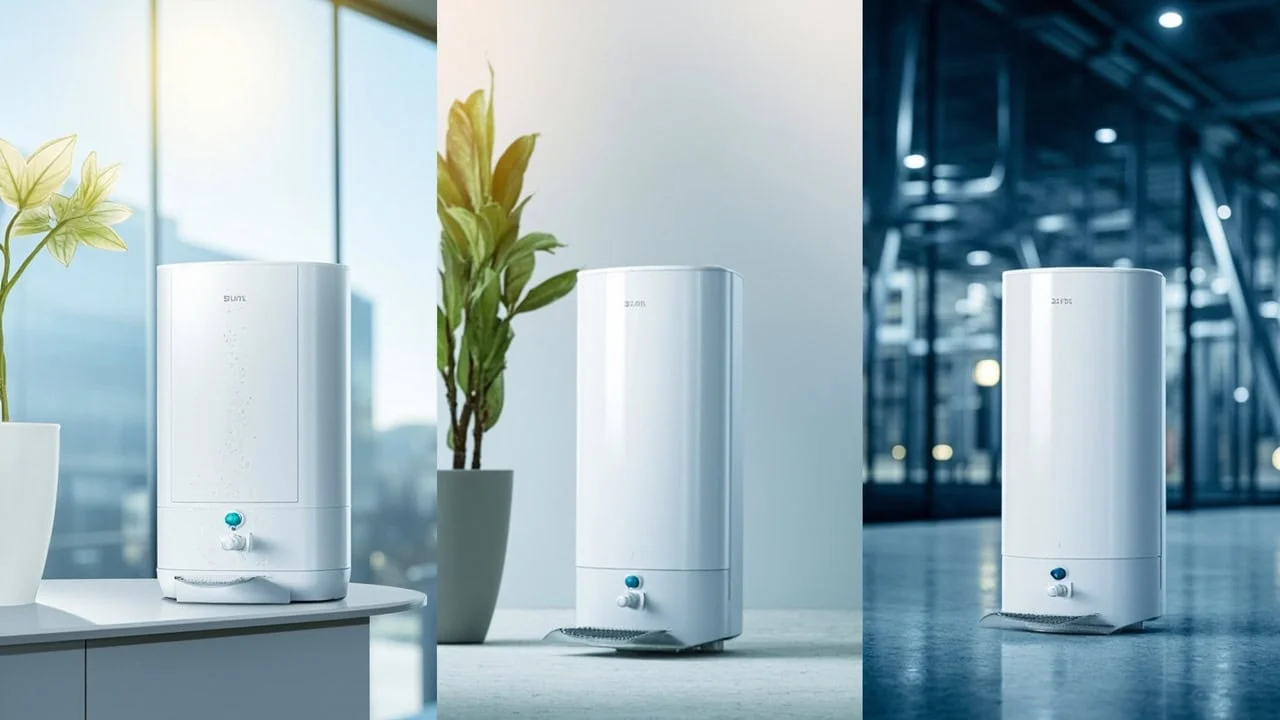
An AWG is essentially a refrigeration dehumidifier with a purification stack. It has four stages:
- Intake — ambient air is drawn through a filter that removes dust and large particles.
- Condensation — the air passes over refrigerated coils. Water condenses on the coils, just like on a cold glass on a summer day. At reference climate (30 °C / 80% RH), a 1 kW AWG makes about 30 L/day.
- Filtration — the condensate passes through sediment, carbon, and reverse-osmosis or UV stages to remove any volatile organic compounds (VOCs) the air might carry.
- Storage and dispensing — the clean water goes into a pressurized tank and is dispensed hot, cold, or room-temperature.
Unlike rainwater, AWG is active continuously — it runs whenever humidity is sufficient, regardless of rain. The same Zenius A100 that produces 100 L/day in Dubai will produce 50 L/day in Riyadh (arid) and 110 L/day in Singapore (humid). See our AWG sizing guide for the full capacity table.
3. Cost Comparison: 10-Year Total Cost of Ownership
For a typical 4-person household in three representative climates, here is the all-in 10-year cost (equipment + installation + maintenance + electricity, ignoring the cost of the roof which is shared infrastructure):
| Climate | Rainwater harvesting (10 yr) | AWG (10 yr) | Notes |
|---|---|---|---|
| Singapore (high rainfall, high humidity) | $1,200 + $200/yr maintenance = $3,200 | $8,000 equipment + $600/yr electricity + $300/yr filters = $17,000 | Rainwater wins on cost; AWG wins on water-quality consistency |
| Dubai (low rainfall, moderate humidity) | $5,000 + $400/yr maintenance (tank cleaning, dry-year top-up) = $9,000 | $8,000 equipment + $500/yr electricity + $300/yr filters = $13,500 | AWG wins on reliability; rainwater still useful for non-potable |
| Riyadh (very low rainfall, low humidity) | $12,000 (large cistern needed) + $1,000/yr maintenance = $22,000 | $12,000 equipment (A1000 needed) + $800/yr electricity + $400/yr filters = $20,800 | AWG wins on cost and reliability |
For larger facilities (hotels, schools, factories), the cost numbers scale roughly linearly, but AWG becomes more competitive at scale because the electricity cost per litre drops and the equipment cost per litre drops faster. See our AWG cost per litre analysis for the full breakdown.
4. Climate Suitability: Where Each System Shines
4.1 Rainwater Harvesting Best Cases
Rainwater harvesting works best in climates with:
- Annual rainfall >600 mm — below this, the system runs dry for too many months to be reliable.
- Predictable wet season — monsoon climates (Singapore, Miami, Mumbai) work well; Mediterranean climates (LA, Athens, Perth) have long dry summers.
- Large usable roof — 100 m² of roof catches ~100 L per mm of rainfall; a 1,000 L tank needs ~10 mm of rainfall to fill from empty.
- No legal restrictions on potable rainwater — some U.S. states (e.g. Colorado, Utah) restrict residential potable rainwater; most other jurisdictions permit it.
4.2 AWG Best Cases
AWG works best in:
- Humidity >50% RH year-round — below 40% RH, output drops below 30% of rated capacity, making the system expensive per litre.
- Temperature >15 °C — below this, the refrigerant cycle becomes inefficient.
- Reliable electricity — AWG needs 0.5–6 kW continuous; not suitable for sites with chronic outages unless paired with backup power.
- Any rainfall pattern — AWG ignores rain entirely.
The sweet spot for AWG is tropical and sub-tropical humid climates (Singapore, Florida, Hong Kong, coastal Brazil) where rainfall might also be high but the demand for guaranteed daily output justifies the higher cost. AWG is also the right choice in arid climates with humidity (Dubai, Abu Dhabi, Doha, Riyadh indoors) where rainfall is too unreliable but humidity still supports condensation.
5. Water Quality Comparison
| Parameter | Rainwater (good system) | AWG (good system) | Municipal tap (reference) |
|---|---|---|---|
| TDS (total dissolved solids) | 10–50 mg/L | 20–80 mg/L | 100–500 mg/L |
| Microbial (E. coli, coliform) | 0 (with UV) | 0 (with UV + RO) | 0 (with municipal treatment) |
| Heavy metals (Pb, Cd, Hg, As) | Below detection | Below detection | Usually below detection; lead-in-pipe risk |
| VOC (volatile organic compounds) | Detectable in urban/industrial areas | Below detection (RO removes) | Below detection |
| pH | 5.5–6.5 (slightly acidic) | 7.5-8.5 (slightly alkaline) | 6.5–8.5 |
| Hardness | Very soft (5–20 mg/L) | Soft to moderate (10–60 mg/L) | Hard (100–300 mg/L) |
AWG advantage: AWG water is more consistent because the source (air) is more uniform than the source (roof catchment, which can pick up dust, pollen, animal droppings, and atmospheric pollutants). AWG also produces slightly alkaline water at pH 7.5-8.5, while rainwater is naturally acidic and may corrode copper plumbing.
Rainwater advantage: rainwater is naturally soft (very low hardness), which is gentler on appliances and gives better soap performance. AWG water is slightly harder but still much softer than municipal water.
For household use, both systems produce drinking-water-quality output when properly filtered. The choice comes down to climate, cost, and reliability — not water quality.
6. Maintenance Comparison
6.1 Rainwater Maintenance
- Gutter cleaning: 2–4 times per year (more if surrounded by trees)
- First-flush diverter cleaning: monthly
- Tank inspection: annually (sediment buildup, mosquito screening, structural integrity)
- Filter replacement: every 6–12 months (sediment + carbon)
- UV lamp replacement: every 12–18 months
- Water quality test: annually
Total annual maintenance time: ~6–10 hours of owner time, plus ~$150–$300 in parts and consumables.
6.2 AWG Maintenance
- Coil cleaning: every 6–12 months (depending on dust load)
- Filter replacement: every 6–12 months (sediment + carbon + RO if present)
- UV lamp replacement: every 12–18 months
- Compressor service: every 24–36 months (industrial-grade units)
- Water quality test: annually
Total annual maintenance time: ~2–4 hours of owner time, plus ~$200–$500 in parts and consumables. For most commercial AWG deployments, a service contract covers all of this for $300–$800/year.
AWG advantage: less hands-on owner maintenance; everything is contained in the unit. Rainwater systems are spread across roof, gutters, tank, and treatment, making failures harder to diagnose.
Rainwater advantage: no electricity needed for collection, so the system works during power outages. AWG stops producing during outages unless backed up.
7. Real-World Case Studies
7.1 Suburban Home, Singapore (rainwater + AWG hybrid)
- Size: 5-person household, drinking-water demand 25 L/day
- Setup: 3,000 L rainwater cistern for non-drinking (toilet, washing, garden) + Zenius A40 for drinking and cooking
- Outcome: 80% of household water from rainwater; 20% (drinking only) from AWG. Annual water cost dropped from $1,400 (municipal + bottled) to $420. Maintenance is 4 hours/year total.
- Lesson learned: Singapore’s rainfall (2,400 mm/year) makes rainwater economically unbeatable for non-drinking, but the family didn’t trust rainwater for drinking — the AWG covers the 20% that needs the highest quality.
7.2 Off-Grid Mountain Cabin, Colorado (rainwater only)
- Size: 2-person cabin, 8 months/year occupancy
- Setup: 5,000 L cistern, 60 m² roof catchment, full filtration with UV
- Outcome: 100% of household water from rain for 8 months/year. During the 4-month dry winter, the cistern is topped up by a 2,000 L truck delivery at $250 per delivery.
- Lesson learned: rainwater works beautifully in a wet mountain climate but fails in extended drought. AWG wasn’t viable here because winter humidity is too low (20–30% RH).
7.3 Resort Hotel, Bali (AWG primary + rainwater backup)
- Size: 80-room boutique hotel, drinking-water demand 600 L/day
- Setup: 2× Zenius A1000 as primary drinking supply + 8,000 L cistern for non-drinking + first-flush diversion
- Outcome: Drinking water consistently meets WHO standards even during the dry season (June–September) when rooftop rainwater would be insufficient. Total annual water cost dropped 32% vs bottled delivery. Hotel markets “water from air” as a sustainability feature.
- Lesson learned: in a humid tropical site, AWG is so reliable that rainwater is reduced to a backup role. The hotel can charge a premium for the sustainability story.
8. Decision Framework: When to Choose Which
After 14 years of deploying both systems across 23 countries, this is the framework we use with every Zenius buyer:
- Start with climate: if rainfall >1,000 mm/year AND humidity >70% year-round, rainwater is the cheaper option for non-drinking; AWG for drinking is still a strong upgrade.
- Estimate total water demand: if demand is >2,000 L/day, AWG wins on cost because the equipment cost per litre drops faster than rainwater tank cost scales up.
- Consider the legal context: if your jurisdiction restricts potable rainwater, AWG removes that risk.
- Consider the failure mode: rainwater fails gradually (tank runs dry); AWG fails suddenly (compressor fault). Which failure mode do you prefer to manage?
- Consider the roof: if there’s no usable roof (apartment, rented space), AWG is your only option of the two.
- Test with a small pilot: in borderline cases, install a 1,000 L rainwater tank or a small A40 AWG, run it for 6 months, and decide based on actual measured output and cost.
8.5 Related Products for Off-Grid Water
These Zenius AWG models pair well with the scenarios in this article:
- A40 40L/Day Home Atmospheric Water Generator — best-selling residential unit, perfect for hybrid rainwater + AWG setups in single-family homes
- Aquaura A100 100L/Day Commercial Atmospheric Water Generator — popular for offices, schools, and small clinics, sized for daily drinking demand of 50–80 people
- A1000 1000L/Day Commercial Atmospheric Water Generator — the workhorse for hotels, mid-size schools, and resort deployments where rainwater alone can’t cover demand
- A10000 10000L/Day Industrial Atmospheric Water Generator — industrial-grade unit for large campuses, military bases, and humanitarian deployments
For the comparison framework, see also our how to size an atmospheric water generator for capacity planning, and our cost per litre of atmospheric water for total-cost comparison.
9. Frequently Asked Questions
Q: Which is cheaper, AWG or rainwater harvesting? A: It depends on climate. In wet climates (rainfall >1,000 mm/year), rainwater is typically 50–70% cheaper for non-drinking use. In arid climates (rainfall <300 mm/year), AWG is cheaper for drinking use because rainwater requires very large tanks. See Section 3 for the 10-year cost comparison by climate.
Q: Can I use rainwater for drinking? A: Yes, with proper filtration and disinfection. Most well-designed residential rainwater systems produce safe drinking water when paired with sediment + carbon + UV. However, some jurisdictions (parts of the U.S. Mountain West, parts of Australia) restrict potable residential rainwater, in which case AWG is the only off-grid drinking-water option.
Q: Can an AWG work in a desert? A: AWG works in deserts if humidity is above ~40% (Dubai, Abu Dhabi, Doha) and works poorly below 30% (Riyadh outdoors, Phoenix mid-afternoon, central Sahara). Indoor installations in arid climates do better than outdoor because temperature is more stable and humidity is slightly higher. The Zenius sizing table covers arid-climate derates explicitly.
Q: Do AWGs use a lot of electricity? A: AWG electricity consumption scales with output. A household A40 uses ~0.35 kW continuous (about $0.05–$0.10/hour at residential rates). A commercial A1000 uses ~6.8 kW continuous. For context, an A1000 produces 1,000 L/day at electricity cost of roughly $40–$80/day depending on local rates.
Q: Which system has lower maintenance? A: AWG has lower owner-time maintenance (2–4 hours/year) but requires periodic professional service ($300–$800/year on a service contract). Rainwater has higher owner-time maintenance (6–10 hours/year) and lower service-contract costs because most tasks are owner-doable. Both systems have similar consumable costs.
Q: Can I combine AWG and rainwater harvesting? A: Yes, and in mixed climates this is often the best answer. Use rainwater for non-drinking (toilet, laundry, garden, cleaning) and AWG for drinking + cooking. The rainwater system is sized for non-drinking demand; the AWG is sized for drinking demand only (typically 20–40% of total household water). This hybrid is the most common Zenius deployment in tropical and subtropical climates.
Q: How long does each system last? A: Properly maintained Rainwater systems last 20–30 years (tanks are typically the first to fail). AWG units last 10–15 years (compressors are the first to fail at year 8–10). Both have replaceable consumables that extend the practical lifetime.
Q: What’s the regulatory status of potable rainwater in different regions? A: Potable residential rainwater is permitted in most of the world, including EU, UK, Australia (with state variations), Canada, Japan, and most of Asia. Restrictions exist in parts of the U.S. Mountain West (Colorado, Utah, parts of California) due to water-rights frameworks that prioritize downstream users. Schools and commercial buildings typically face fewer restrictions than residential in restrictive states. In Australia, Queensland and NSW are the most permissive; Western Australia and South Australia require rainwater plumbing to be clearly marked and inspected annually.
Q: Which is better for emergency prep / disaster response? A: AWG is generally better for disaster scenarios because it requires only power (which can be backed up by generator or solar) and produces water continuously regardless of rainfall. Rainwater harvesting depends on rainfall patterns and storage tank size; in a sustained drought, wildfire, or earthquake scenario, the tank may run dry. For disaster-prone deployments (earthquake zones, wildfire regions, refugee camps, off-grid communities), AWG with backup power is the more resilient choice.
10. Talk to a Water-Systems Specialist
If you’re weighing AWG vs rainwater harvesting for a home, school, hotel, or facility, contact our water-systems team with your location, roof area (if known), and approximate water consumption. We typically respond within one business day with a draft recommendation and side-by-side cost model.
For deeper context on the AWG side, see our AWG capacity planning guide, our atmospheric water generator running cost, and our AWG for schools guide. For a broader view of AWG technology, start with our what is an atmospheric water generator? primer.
See also: related Zenius resources
TL;DR: AWG vs rainwater harvesting: in wet climates (Singapore 2400mm rain), rainwater wins 50-70% on cost. In arid climates (Riyadh <100mm), AWG wins on reliability. Hybrid systems work in mixed climates. Zenius recommends rainwater for non-drinking uses, AWG for drinking.
- Household AWG product line
- Commercial AWG product line
- UAE deployment guide
- Saudi Arabia deployment guide
- Hotels & Resorts industry guide
- Schools & Universities industry guide
See also: regional deployment guides
- Qatar deployment guide
- Bahrain deployment guide
- Kuwait deployment guide
- Oman deployment guide
- Dubai deployment guide
AWG vs Rainwater by Climate Zone (10-Year TCO)
Compare total cost of ownership across 3 climate zones over 10 years (100 L/day household):
| Climate Zone | AWG (10y) | Rainwater (10y) | Bottled (10y) |
|---|---|---|---|
| Tropical (Singapore, 2400mm rain) | $2,200 | $1,400 | $5,500 |
| Mediterranean (Athens, 400mm rain) | $2,500 | $3,200 | $5,500 |
| Hot Arid (Dubai, 100mm rain) | $2,800 | $8,500+ | $7,300 |
| Cold Arid (Riyadh, 50mm rain) | $3,200 | $15,000+ | $7,300 |
Background reading: our explainer on atmospheric water generator technology.