Hangzhou Zenius New Energy Co., Ltd.
-
+86 158-8822-2598


Atmospheric Water Generator for Home: Countertop Units, Sizing and Running Costs
Quick Answer: A home atmospheric water generator is a point-of-use appliance that condenses humidity and purifies it through sediment, activated carbon, UV-C or reverse osmosis and remineralisation. A household of four drinks and cooks on roughly 16 to 25 litres a day in a mixed climate, which points to a 20 to 40 L/day countertop or floor-standing unit. Home units in the 12 to 70 L/day band cost roughly $800 to $2,500 to buy and $80 to $300 a year to run.
A home atmospheric water generator solves a specific problem: the water you drink and cook with, without buying it in bottles and without trusting the pipe it arrives through. It is not a replacement for your plumbing and it is not a swimming-pool filler. Understanding exactly which job you are buying it for is the difference between a machine used daily for a decade and an expensive counter ornament.
New to the category? Read what an atmospheric water generator is first, then come back for the sizing and cost detail.
1. What a Home AWG Actually Replaces
Three things, in descending order of how often buyers are happy with the swap:
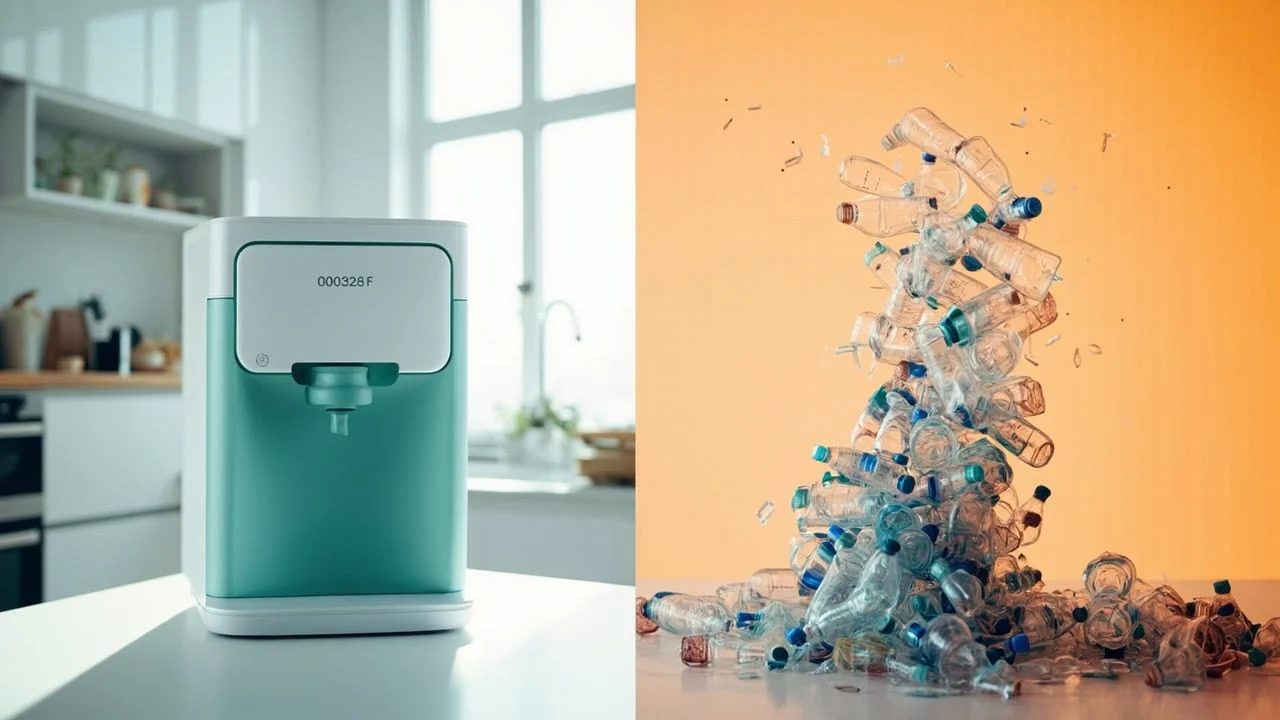
- Bottled water. The strongest case. If a household of four buys 4 to 8 litres a day in bottles, the payback arithmetic is straightforward and our bottled-water comparison runs the numbers.
- Jug and cooler deliveries. Offices and villas with a weekly delivery contract. The saving here is logistics as much as money.
- Tap or faucet filters. A weaker case on cost, a stronger one on independence. If your municipal supply is reliable and tested, buy an AWG for taste, for emergency resilience, or because the supply is intermittently unsafe — not to save money.
Household demand is smaller than most buyers think. The WHO treats 2 to 3 litres per person per day as the basic drinking-water minimum; add 1 to 2 litres for cooking and hot drinks and you arrive at 3 to 5 litres per person per day. It comfortably covers drinking, cooking, tea, coffee and infant formula.
2. Countertop, Floor-Standing or Whole-House?
| Format | Typical capacity | Best for | Trade-off |
|---|---|---|---|
| Countertop / desktop | 12–20 L/day | Couples, apartments, home offices | Needs bench space; smallest buffer tank |
| Floor-standing cabinet | 20–70 L/day | Families, villas, small offices | Floor area and a drainage point |
| Split-type | 40–70 L/day | Quiet kitchens, open-plan living | Compressor sits outdoors or on a balcony |
| Whole-house central plant | 100 L/day and up | Large villas with full plumbing demand | Installation project, buffer tank, plant space |
Most households land in row two. If you are tempted by row four, read our whole-house AWG guide first — the honest answer is that above about 100 litres a day, a central plant with a 200 to 500 litre buffer tank becomes worth considering, and below that it is over-engineering.
3. Sizing by Household
Use demand, not a catalogue. Daily demand (L/day) = (residents × 4 L) + (visitors × 2 L) + process water.
- 1–2 people: 6–12 L/day → a 12 L/day unit such as the Aquaura A12.
- 3–4 people: 16–25 L/day → a 20 L/day unit (A20), or 30–40 L/day in an arid climate (A40).
- 5–6 people or a home office: 25–35 L/day → 40–70 L/day (A40, A70).
Two sized-down machines usually beat one oversized machine. An oversized unit short-cycles and produces less water per kilowatt-hour, while two units let you match output to the season and keep one running while the other is serviced.
4. What It Costs to Buy and to Run
Home units in the 12 to 70 L/day band generally sell for $800 to $2,500, with price driven by capacity, compressor quality, the purification train and the finish. Our cost-per-litre analysis covers the long-run arithmetic.
Running costs are dominated by electricity. Expect 0.3 to 0.5 kWh per litre, so a 20 L/day household unit uses about 6 to 10 kWh a day — roughly what a modern refrigerator draws. Filters and consumables add to an annual cost of about $80 to $300. Full energy detail: AWG electricity consumption.
5. Noise, Heat and Where It Lives
A home AWG is a refrigeration appliance, so it makes sound and rejects heat. Household units run roughly 35 to 55 dB depending on model and load — at the low end it blends into daytime background, at the top end it is noticeable at night. The Aquaura A12 measures 45 dB at one metre; school-grade A-series units are 42 dB or below. Always ask for the figure measured at one metre, because a decibel number without a distance is not comparable between suppliers. Where absolute quiet matters more than capacity, the split-type A70 moves the compressor outdoors or onto a balcony. See AWG noise levels.
Placement rules: free air on the intake and condenser faces, a level floor, a nearby drain or a condensate container you will actually empty, and no direct sun. A unit in a sealed cupboard will underperform and eventually trip.
6. Water Quality, Taste and Minerals
Condensed water is extremely pure — which is exactly why good machines remineralise. The path is sediment → activated carbon → UV-C or RO membrane → mineralisation, with calcium and magnesium added back to stabilise pH and taste. Without that last stage, water tastes flat.
Two pages worth reading if quality is your deciding factor: is AWG water safe to drink, and does an AWG remove PFAS. Independent testing matters more than any claim on a brochure: our platforms are covered by SGS water-test reports against WHO drinking-water guidelines, listed on the certifications page.
7. The Maintenance Calendar
- Every 3–6 months: air-side pre-filter and sediment filter.
- Every 6 months: activated carbon block.
- Annually: RO membrane and UV-C lamp.
- Annually: tank sanitisation and a full wipe-down of the condensate path.
Keep to it and the machine lasts: household units are engineered for roughly 8 to 12 years of service, and A-series and ZEN-series units carry a two-year parts-and-labour warranty. The useful question to ask any supplier is not the warranty length but who ships the part and how fast — see lifespan and warranty.
Not sure which model fits your kitchen? Tell us your household size, climate and available space — an engineer will reply with a sized recommendation within one working day. You can also compare models in our 20 L comparison and 10 L comparison.