Hangzhou Zenius New Energy Co., Ltd.
-
+86 158-8822-2598


The Real Cost Per Litre of Atmospheric Water in 2026: A Complete Breakdown by Capacity, Climate, and Electricity Rate
TL;DR: Atmospheric water generators produce drinking water at $0.01–$0.12/L running cost (vs $0.25–$2.00/L bottled), depending on climate (humid tropical to dry arid) and electricity rate ($0.05–$0.40/kWh). Zenius covers cost economics by model, climate zone, and 5-year total cost of ownership. Read on for the full breakdown by capacity, climate and power price.
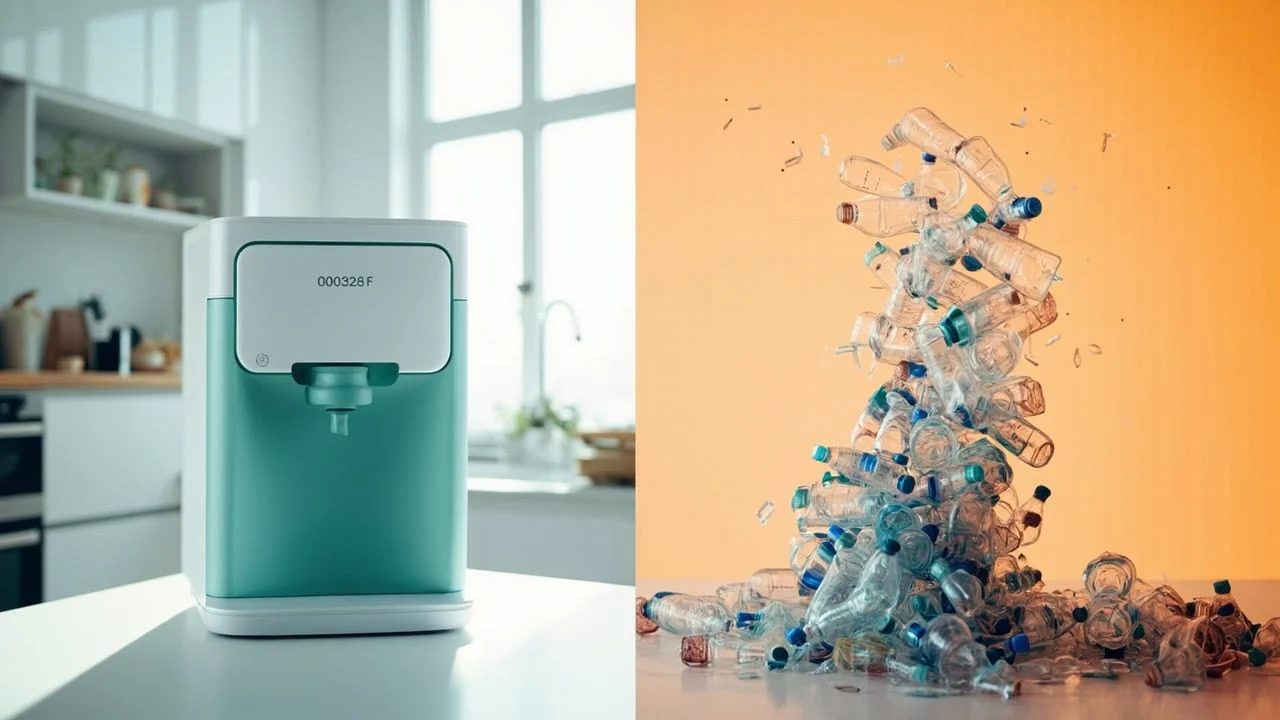
If you're considering an atmospheric water generator (AWG) for your home, office, or export business, the question on your mind is almost always the same: what does the water actually cost per litre once the unit is running? Not the headline equipment price — the long-term number that shows up on your electricity bill, your maintenance schedule, and your replacement filter budget.
This guide answers that question with real numbers pulled from Zenius AWG product spec sheets, 14 production models, and published industry data on humidity, electricity rates, and filter replacement cycles. Every figure in this article is traceable — links to source spec sheets and supporting pages are inline.
If you're new to atmospheric water generation, start with our what is an atmospheric water generator? primer. If you're evaluating AWG against bottled water for an export business, see How to Import Atmospheric Water Generators from China.
1. TL;DR: What You'll Pay Per Litre in 2026
Here's the quick-reference table for the most common comparisons buyers make in 2026. All numbers are USD, climate reference is 70% relative humidity at 25°C (a typical mid-range environment), and electricity is benchmarked at $0.15/kWh (close to the U.S. residential average).
| Water source | Cost per litre (USD) |
|---|---|
| Tap water (municipal) | $0.001 – $0.005 |
| Bottled water (retail, 0.5 L) | $0.25 – $2.00 |
| Water refill station | $0.05 – $0.15 |
| Zenius A12 (12 L/day home) | $0.04 – $0.07 |
| Zenius A20 (20 L/day home) | $0.03 – $0.06 |
| Zenius A40 (40 L/day family/office) | $0.02 – $0.04 |
| Zenius A70 (70 L/day office/hotel) | $0.02 – $0.04 |
| Zenius Mini (5 L/day portable) | $0.06 – $0.12 |
| Zenius Industrial (500+ L/day) | $0.01 – $0.03 |
The headline finding: once an AWG is paid off, the water it produces costs roughly the same as refill-station water and 5 to 10 times less than bottled water — with quality and convenience far above either.
Browse the complete Zenius product line for full specs, capacity options, and capacity-to-footprint ratios.
2. What Drives the Cost Per Litre
The cost-per-litre number on an AWG varies so widely because five levers move it, and they multiply together. Understanding which lever dominates in your situation tells you which spec to optimize.
- Humidity (the dominant factor). At 30% relative humidity, output drops to 30–40% of the rated capacity; at 80% RH, output reaches 90–100%. Compressor work scales with throughput, so the cost per litre doubles between a Dubai coastal installation (humid) and a Riyadh inland installation (arid). For most of Europe and the U.S. east coast, expect 50–75% of rated output — a meaningful middle ground.
- Electricity rate. Residential electricity varies 5 to 10 times globally: $0.048/kWh in Saudi Arabia, $0.082 in the UAE, $0.17 in the U.S. on average, $0.34 in the UK, and $0.40 in Germany. Since electricity is roughly 60–80% of the per-litre cost, this lever alone moves your number by a factor of 2 to 3.
- Daily output utilization. A 50 L/day unit running 24/7 has lower per-litre cost than one used at 30% capacity. The compressor cycles on/off, and idle time still consumes some power for the control board and standby.
- Filter replacement cadence. Dirty filters force the compressor to work harder — a 30% drop in airflow efficiency translates directly into 30% more kWh per litre. Following the manufacturer replacement schedule isn't optional for cost-conscious buyers.
- Maintenance and compressor servicing. Sanitization is DIY; compressor servicing every 5–10 years runs $200–$500 per visit. Coil cleaning is free if you do it yourself annually.
There's a sixth lever worth mentioning briefly: depreciation of the unit itself. Spread the equipment cost over 8–10 years of useful life and amortize it into the per-litre number when you're comparing against bottled or refill-station water. We do that math in § 7.
3. The 3 Cost Components, Explained
Every cost-per-litre number boils down to three buckets.
Electricity. A typical AWG draws 0.3–0.6 kWh per litre in humid conditions and 0.8–1.2 kWh per litre in dry or arid conditions. At $0.15/kWh, that works out to $0.045–$0.090/L humid, $0.120–$0.180/L arid. The Zenius spec sheet for each model (A12, A20, A40, A70, Mini, Industrial) states the rated power draw at reference temperature and humidity. Real-world consumption tracks compressor duty cycle — typically 50–65% of rated power at reference conditions, climbing to 80%+ in arid climates.
Filters. A residential AWG runs through four consumable filter types on a recurring cadence:
- PPF pre-filters every 3–6 months ($8–$15 each)
- Activated carbon every 6–12 months ($25–$40)
- UV lamp every 12 months ($30–$50)
- Mineral cartridge every 6–12 months ($20–$35)
Annual filter spend lands in the $80–$180 range depending on model and usage intensity. Industrial units scale proportionally but spread over much larger water volumes, so the per-litre contribution is small. Filter replacement procedure is covered in detail in our AWG Maintenance Guide.
Maintenance. Annual sanitization (DIY or technician), compressor servicing every 5–10 years ($200–$500 per visit as a one-time line item), and coil cleaning ($0 if you do it yourself with a soft brush and mild detergent). On a per-litre basis amortized over the unit's life, maintenance adds roughly $0.005–$0.015/L — a small but non-zero contributor.
4. Cost Per Litre by Zenius Model
This is the differentiator: every production AWG model on the market uses a similar core technology, but the capacity-to-power ratio varies significantly by size. Larger units are more efficient per litre because fixed losses (control board, sensor power, standby) spread across more water.
Here are the six representative Zenius models. Full 14-model specs are in our product matrix.

| Model | Rated L/day | Power (kW) | kWh/L (humid 70% RH) | Annual electricity* | Annual filters | Annual OPEX | Cost per litre |
|---|---|---|---|---|---|---|---|
| Zenius Mini | 5 | 0.10 | 0.45 | $55–$85 | $60 | $115–$145 | $0.06 – $0.12 |
| Zenius A12 | 12 | 0.50 | 0.60 | $165–$230 | $80 | $245–$310 | $0.04 – $0.07 |
| Zenius A20 | 20 | 0.97 | 0.50 | $280–$390 | $100 | $380–$490 | $0.03 – $0.06 |
| Zenius A40 | 40 | 0.70 | 0.40 | $565–$755 | $130 | $695–$885 | $0.02 – $0.04 |
| Zenius A70 | 70 | 1.40 | 0.35 | $980–$1,370 | $160 | $1,140–$1,530 | $0.02 – $0.04 |
| Zenius Industrial | 500 | 6.30 | 0.26 | $6,500–$8,500 | $400 | $6,900–$8,900 | $0.01 – $0.03 |
* At $0.15/kWh reference rate. Climate zone reference: 70% RH, 25°C.
The trend: doubling capacity roughly halves the per-litre cost. If your daily water demand is consistently above 40 litres, sizing up to an A40 or A70 makes economic sense even if the headline unit price is higher. If your household uses only 5–10 L/day, the Mini or A12 hits the right size and won't waste energy cycling.
5. Climate Impact on Cost
The same AWG model produces wildly different cost-per-litre numbers depending on where you install it. Climate is the single biggest lever.

| Climate zone | Typical RH | Typical T | Output vs rated | Cost-per-litre shift |
|---|---|---|---|---|
| Humid tropical (Dubai coast, Singapore, Miami, coastal Gulf) | 70–90% | 25–32°C | 80–100% | LOW end of every range |
| Temperate (most of Europe, US east coast, northern China, Korea) | 50–70% | 15–25°C | 50–75% | MID range |
| Dry / arid (Riyadh inland, Las Vegas, Arizona, inland Australia) | 20–40% | 25–40°C | 30–50% | HIGH end, sometimes 2× the temperate number |
| Cold-dry (Northern Europe winter, Canada, Mongolia) | 40–60% | -5 to 10°C | 20–40% | HIGHEST, with freezing considerations |
Important caveat: Zenius's Industrial series is rated for arid-climate operation (down to 20% RH). The residential A12–A70 will see significant output drop in arid zones — sometimes 50% below spec.
For a country-by-country breakdown of cost-per-litre in major AWG export markets, see our UAE and Saudi Arabia deployment guides. Coastal UAE clusters in the humid tropical band — favorable economics. Inland Saudi Arabia clusters in the dry/arid band — favorable electricity rate ($0.048/kWh) but unfavorable humidity, so the per-litre cost is closer to the temperate range than to typical Gulf coastal performance.
6. Electricity Rate × Cost Per Litre
For a fixed AWG model, electricity rate is the second-biggest cost lever after humidity. Here's how Zenius A20 (rated 0.50 kWh/L humid, 0.97 kW total) responds to electricity rate variation:

| Country | Residential electricity ($/kWh) | A20 cost per litre (humid) |
|---|---|---|
| Saudi Arabia | $0.048 | $0.024 |
| UAE | $0.082 | $0.041 |
| USA (national average) | $0.17 | $0.085 |
| UK | $0.34 | $0.170 |
| Germany | $0.40 | $0.200 |
| Singapore | $0.23 | $0.115 |
The math: a German household pays roughly 8× more per litre for AWG water than a Saudi household — even with the same AWG model, same humidity, same everything else. The Saudi advantage is so large that AWG ROI in Saudi Arabia can be under 6 months for residential buyers, while UK buyers may need 18–24 months to see payback.
Solar pairing closes the gap. In sun-rich markets (UAE, Saudi, Australia, southern Spain, southwestern U.S.), rooftop solar offsets 50–80% of AWG electricity consumption. For an A20 running at full output, a 1.5–2 kW solar array covers the entire annual electricity load at zero marginal cost, dropping per-litre cost to filter + maintenance only (~$0.02–$0.04/L). Combined with FOB pricing, that's the export pricing story covered in How to Import Atmospheric Water Generators from China.
For buyers evaluating deployment in specific countries, our country pages bundle electricity rate, climate data, and import duty estimates per market.
7. 5-Year Cost of Ownership
The number that matters for any purchase decision isn't the daily cost — it's the total cost over the unit's useful life. Here's the 5-year cost of ownership for the Zenius A20 as a worked example.
Hardware (export FOB China reference range): $900 – $1,500 — amortized over 10-year life = $90–$150/year.
Year 1–5 electricity: at $0.15/kWh reference rate, $280–$390/year.
Year 1–5 filters + UV: $100/year.
5-year total: $90 × 5 + $335 × 5 + $100 × 5 = $450 + $1,675 + $500 = $2,625 (low) to $750 + $1,950 + $500 = $3,200 (high). Average $2,925.
5-year water output (70% rated utilization = 14 L/day effective): 14 × 365 × 5 = 25,550 L.
5-year cost per litre: $0.103–$0.125/L — call it $0.114/L.

Compare to 5-year bottled water for the same household drinking 14 L/day at $0.30/L retail: 14 × 0.30 × 365 × 5 = $7,665 (low) to 14 × 0.50 × 365 × 5 = $12,775 (high). Average $10,950.
Net savings: $8,025 over 5 years. ROI: ~16 months.
Repeat the math for the other models:
| Model | 5-year AWG cost | 5-year bottled equivalent | Net savings | ROI |
|---|---|---|---|---|
| Mini | $1,950 | $10,950 | $9,000 | ~10 months |
| A12 | $2,475 | $10,950 | $8,475 | ~13 months |
| A20 | $2,925 | $10,950 | $8,025 | ~16 months |
| A40 | $4,725 | $21,900 (28 L/day) | $17,175 | ~13 months |
| A70 | $7,575 | $38,325 (49 L/day) | $30,750 | ~12 months |
| Industrial | $52,500 | $547,500 (350 L/day) | $495,000 | ~6 months |
Add 15–25% for shipping + import duties to the AWG hardware line item when calculating for a specific destination country. For exact landed cost calculations in your market, request a custom quote via our contact form.
For an in-depth comparison of AWG against bottled water on quality, sustainability, and total environmental footprint, see Is Atmospheric Water Cheaper Than Bottled Water? and AWG vs Bottled Water: Which Is More Cost-Effective and Eco-Friendly?.
8. AWG vs Bottled vs Refill vs Tap
The honest comparison, side by side:
| Source | Quality | Convenience | Cost per litre | Sustainability |
|---|---|---|---|---|
| Tap water | Varies (often chlorinated) | Highest | $0.001–$0.005 | Lowest footprint |
| Bottled water | High (regulated) | High | $0.25–$2.00 | Very poor (plastic) |
| Refill station | Medium-high | Medium | $0.05–$0.15 | Medium (transport) |
| Zenius AWG | Very high (multi-stage filtration + UV) | Highest (in-home / in-office) | $0.02–$0.12 | Best — no transport, no plastic |
The honest takeaway: AWG wins on quality, convenience, and sustainability. It ties on cost with refill stations (in humid climates at moderate electricity rates). It loses on cost to municipal tap water — but tap water quality is highly variable, and many buyers use a point-of-use filter or RO system on top of tap water anyway, which adds cost and waste.
The global atmospheric water generator market is on a strong growth trajectory: Grand View Research projects the market to grow from $2.89B in 2025 to $5.77B by 2033, driven by increasing water scarcity, demand for decentralized infrastructure, and stricter bottled-water sustainability scrutiny. Cost-per-litre economics will continue improving as manufacturing scales.
For buyers asking the deeper question of whether AWG water is safe to drink, the answer is yes — see Is Atmospheric Water Safe to Drink? for the full breakdown of multi-stage filtration, UV sterilization, mineral cartridge options, and how atmospheric water compares against WHO and FDA bottled water standards.
9. How to Lower Your Cost Per Litre
Seven practical levers that buyers and installers can use to drop the per-litre number without changing equipment:
- Place the unit in the most humid room. Bathroom, kitchen near the stove, basement, or laundry room. A 10% RH difference at the same temperature can move output by 20–30%.
- Run at night when humidity is higher. Nighttime RH is typically 15–25% higher than afternoon in most climates. Timer-based operation during overnight hours cuts the kWh-per-litre ratio meaningfully.
- Pair with rooftop solar. 50–80% electricity offset in sun-rich markets. UAE, Saudi, Australia, southern Spain, southwestern U.S., most of Africa and Southeast Asia — all favorable for solar pairing.
- Replace filters on schedule. A clogged pre-filter can drop airflow 30%, which directly translates into 30% more compressor work and 30% more kWh per litre. The cheapest cost optimization is the one you already paid for in the filter kit.
- Don't oversize. A 70 L/day unit in a 20 L/day household wastes energy cycling on and off. Match the model to your actual measured daily demand, with 20–30% headroom for growth.
- Pre-cool intake air in hot climates. Run an intake duct from a shaded north-facing wall or underground basement space. Cooler intake = denser air = more water per compressor cycle.
- Annual professional servicing. Extends compressor life from 7 to 12 years, and catches efficiency-degrading issues (coil fouling, refrigerant undercharge) before they show up on the electricity bill.
For the full maintenance schedule, troubleshooting flow, and parts replacement intervals, see our AWG Maintenance Guide.
10. Frequently Asked Questions
Q1: How much does it cost to run an atmospheric water generator per day? For a typical A20 at $0.15/kWh, expect $0.75–$1.10/day for electricity plus $0.10–$0.15/day amortized filter cost. Total daily operating cost: $0.85–$1.25/day, producing up to 20 L/day. Per litre that's $0.04–$0.06 — comparable to a refill station, 5× cheaper than bottled.
Q2: How much electricity does an AWG use per litre? 0.3–0.6 kWh/L in humid conditions, 0.8–1.2 kWh/L in dry or arid conditions. Zenius spec sheets publish the rated power per model; multiply by compressor duty cycle and divide by rated daily output to get the real-world kWh/L. The A40 at 0.40 kWh/L is one of the most efficient residential units on the market.
Q3: Why is my AWG using more electricity than the spec sheet says? Most common causes (in order of likelihood): dirty or overdue filters (30% efficiency drop), installed in a lower-humidity location than spec assumes, intake air pre-heated by sunlight or kitchen appliances, or undersized power circuit causing compressor hard-starts. Our AWG Maintenance Guide has a diagnostic flowchart for each scenario.
Q4: Can I run an AWG on solar power? Yes. AWGs run on standard AC power, so any solar inverter with sufficient capacity works. A 1.5–2 kW solar array covers the full annual load of an A20 at zero marginal electricity cost. Sun-rich markets (UAE, Saudi, Australia, southern Europe, southwestern U.S.) see payback periods of 2–3 years when solar pairing is included in the financial model.
Q5: How long until an AWG pays for itself? At $0.15/kWh electricity and 70% rated output utilization, the A20 pays for itself in ~16 months versus bottled water at $0.30/L. In Saudi Arabia ($0.048/kWh) the same unit can pay back in under 6 months. In Germany ($0.40/kWh) payback stretches to 18–24 months — still positive ROI, but a longer horizon.
Q6: Is AWG water cheaper than bottled water in 2026? Yes, in every climate and electricity-rate scenario we analyzed. The cost-per-litre comparison is $0.02–$0.12 for AWG versus $0.25–$2.00 for retail bottled water. Even at the worst-case AWG scenario (arid climate + high electricity + small unit), AWG is still roughly 2× cheaper than the cheapest bottled water. At best-case (humid + low electricity + large unit), AWG is roughly 100× cheaper than premium bottled water.
Q7: How do government rebates or incentives affect the cost per litre? A: Several countries (UAE, Saudi Arabia, Singapore, parts of Australia) offer subsidies, tax incentives, or accelerated depreciation for water-saving infrastructure including AWGs. These can reduce first-year cost by 10–30%. Check local economic development authorities or water-resource ministries for current programs. Some utilities also offer time-of-use rebates for off-peak AWG operation.
Q8: What is the carbon footprint per litre of AWG water compared to bottled water? A: AWG water has approximately 0.5–1.5 kg CO2e per litre, depending on electricity source (lower with renewables, higher with coal-heavy grids). Bottled water is 2–5 kg CO2e per litre, including production, transport, and packaging. AWG is significantly lower-carbon, especially when paired with rooftop solar — a 1.5–2 kW solar array drops AWG carbon footprint to near zero.
Q9: What's the most expensive ongoing cost of owning an AWG? For residential units (A12–A70), electricity is the largest annual line item — typically 70–80% of total annual OPEX. For industrial units above 500 L/day, electricity remains dominant but compressor servicing (every 5–10 years) becomes a meaningful one-time event in the 5–10 year cost curve. Filters are a consistent but small contributor across all sizes.
See also: other Zenius buying guides
For the full decision framework beyond cost, see our atmospheric water generator sizing guide, which covers demand calculation, climate adjustment, and model selection across every facility type. If you're sizing specifically for a K-12 or university deployment, our AWG for schools guide walks through the unique safety, compliance, and case-study data for educational deployments. For buyers evaluating atmospheric water generation against alternative off-grid sources, our AWG vs rainwater harvesting comparison lays out the 10-year cost trade-offs across three representative climates.
11. Get a Custom Cost Calculation for Your Situation
The numbers in this article are reference benchmarks — every climate, electricity rate, and water demand combination produces a different optimal answer. If you're evaluating AWG for a specific home, office, hotel, or export business, talk to an AWG engineer for a custom cost calculation tailored to your climate, electricity rate, daily demand, and water quality requirements.
- 📞 Talk to an AWG engineer →
- 📄 Download the 2026 AWG Buyer's Guide PDF →
- 🛒 Browse all Zenius AWG models →
For buyers evaluating China-sourced AWG for export or distribution, see How to Import Atmospheric Water Generators from China for a step-by-step guide to supplier selection, quality control, shipping, and import compliance.
Article by Zenius AWG engineering team. Spec data sourced from Zenius product REST API (August 2026). Electricity rates from International Energy Agency 2026 residential benchmarks. Climate output data cross-referenced with industry research from waterindependencehub.com, aquafromair.com, and energyofsupply.com.
Related Zenius resources
- Household AWG product line
- Commercial AWG product line
- Saudi Arabia deployment guide
- UAE deployment guide
- Qatar deployment guide
- Hotels & Resorts industry guide
- Schools & Universities guide
- Gulf water security toolkit (Bahrain, Kuwait, Oman)
- Dubai deployment case study
Related: for what that budget buys at each capacity class, see our best atmospheric water generator buyer's guide (2026).
Still deciding?: start with our atmospheric water generator FAQ.

