Hangzhou Zenius New Energy Co., Ltd.
-
+86 158-8822-2598


How Does an Atmospheric Water Generator Work? The Complete 2026 Guide
TL;DR: An atmospheric water generator (AWG) extracts drinking water from air humidity using condensation: a compressor cools air below its dew point, water vapor condenses on refrigerated coils, then passes through multi-stage filtration (sediment + carbon + UV or reverse osmosis) to meet WHO standards. Output: 0.3-0.6 kWh/L.
Quick Answer: An atmospheric water generator (AWG) works by drawing ambient air through a filter, chilling it below its dew point so water vapor condenses on refrigerated coils, then purifying the condensate through sediment, carbon and UV/RO stages into safe drinking water. At 30°C and 80% relative humidity, a 1 kW machine produces roughly 30 litres per day.
Atmospheric water generators sound like science fiction: a machine that pulls clean, drinkable water out of thin air. Yet the technology inside every AWG is over a century old, battle-tested in millions of air conditioners and dehumidifiers worldwide. In this guide, we break down exactly how an AWG works — stage by stage — how much water it can produce, how much electricity it needs, and the three factors that decide whether the machine in front of you will hit its rated output.
This guide complements our atmospheric water generator sizing guide and our atmospheric water generator cost per litre. If you want the “how” before the “how much,” start here.
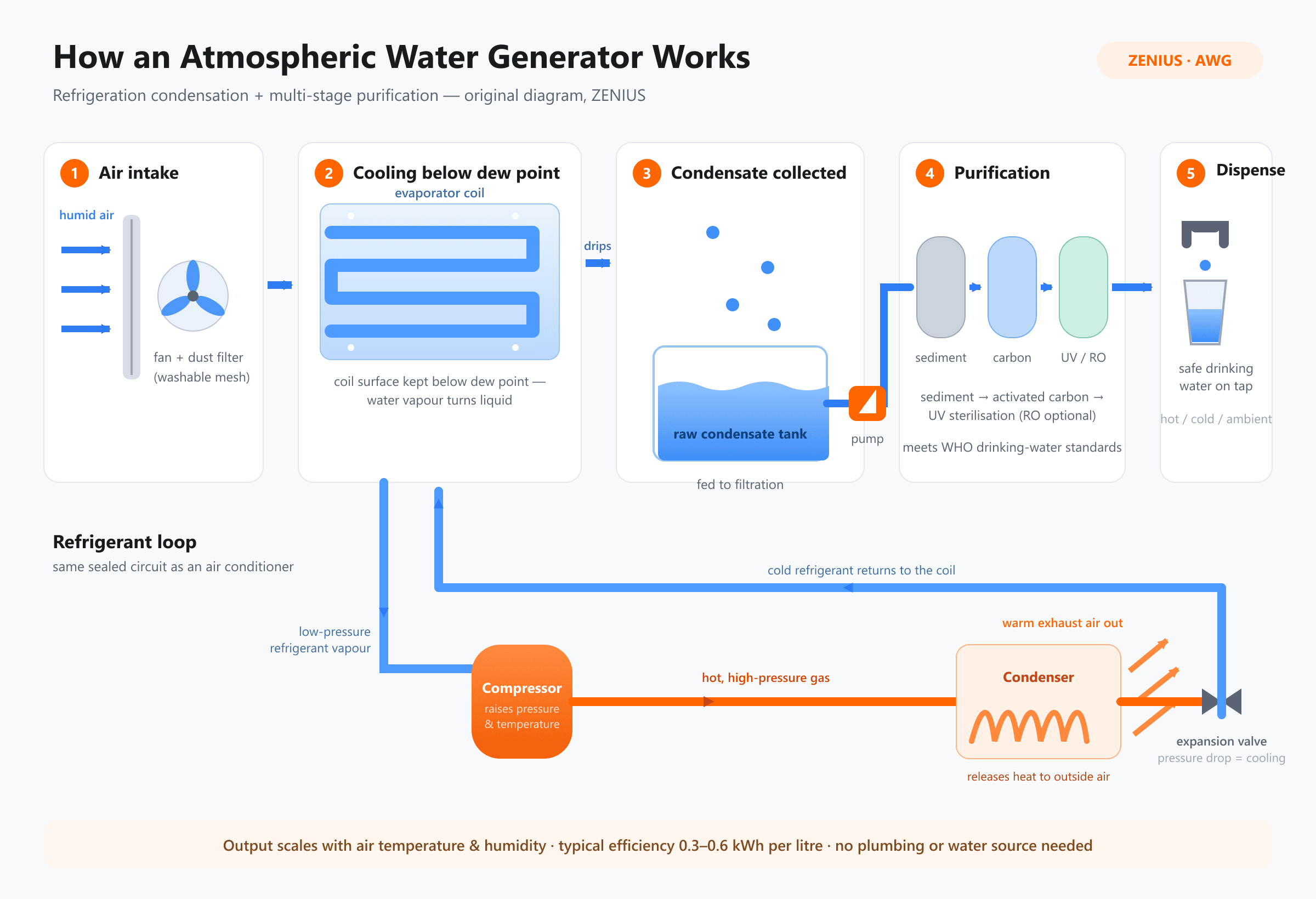
The diagram below shows the whole journey in one view: five stages on top, and the sealed refrigerant loop that keeps the coil cold underneath.
1. The Short Answer: Condensation Plus Filtration
An atmospheric water generator is, at its core, a refrigeration dehumidifier with a drinking-water purification stack attached. The air around you always contains moisture — even desert air at 20% relative humidity holds several grams of water per kilogram of air. An AWG’s job is to capture that moisture, collect it, purify it, and dispense it as safe drinking water.
The full process takes about 30 minutes from switching the unit on to pouring the first glass, and then it produces water continuously for as long as humidity and power are available.
2. The Five Stages Inside an AWG
Stage 1 — Air Intake and Pre-Filtration
A fan draws ambient air through a washable mesh or HEPA-grade filter that removes dust, pollen, and airborne particles. This protects the machinery downstream and keeps the condensed water cleaner from the very first drop. In dusty environments (construction sites, desert installations), pre-filters are the first maintenance item you’ll touch — see our AWG maintenance guide for the full service schedule.
Stage 2 — Condensation
The filtered air passes over a set of coils chilled to below the local dew point by a refrigeration compressor — the same physics that makes a cold drink “sweat” on a humid day. When air touches a surface colder than its dew point, water vapor condenses into liquid.
- Refrigeration type (compression cycle): the standard. High output, best efficiency above 15 °C and 40% RH. This is what powers the Zenius A-series, from the 40 L/day household units to the 6,000 L/day commercial systems.
- Desiccant type: a moisture-absorbing material captures water first, then releases it when heated. Better for low-humidity or low-temperature climates, at the cost of higher energy use per litre.
Stage 3 — Multi-Stage Purification
Condensate is technically distilled water, but it has passed through air — so it can pick up trace VOCs and microbes along the way. A serious drinking-water AWG therefore includes a purification chain, typically:
- Sediment filter — removes particulates.
- Activated carbon filter — adsorbs VOCs, odors, and organic compounds.
- Reverse osmosis (on commercial units) or UV-C sterilization — kills bacteria and viruses; RO also removes dissolved solids.
- Post-carbon and mineralization stage — restores taste by adding back beneficial minerals such as calcium and magnesium.
The result is water that consistently meets WHO drinking-water guidelines — and in many deployments, beats the quality of the local bottled-water supply.
Stage 4 — Storage and Re-Circulation
Purified water drains into a food-grade storage tank, typically 15–40 L on household units and 500 L+ on commercial systems. Quality units keep the stored water healthy with an automated cycle: the tank water is re-filtered and UV-treated every few hours, so water sitting in the machine is never “stale.”
Stage 5 — Dispensing and (Optionally) Chilling/Heating
Water is dispensed hot, cold, or ambient through the tap — household and office units work exactly like a water dispenser. Commercial systems pipe water onward to drinking fountains, kitchens, or bottling stations.
3. How Much Water Can an AWG Actually Produce?
Rated output is always quoted at a reference climate. The industry standard reference is approximately 30 °C and 80% relative humidity, where a 1 kW machine produces roughly 30 L/day. Real-world output scales with the moisture actually in the air:
| Climate condition | Approx. output vs. rated | Where this applies |
|---|---|---|
| 30 °C / 80% RH (tropical, coastal) | 100% | Singapore, Lagos, Jakarta, coastal Gulf in summer |
| 25 °C / 60% RH (mixed/temperate summer) | 60–75% | Mediterranean, inland China, southern US |
| 20 °C / 40% RH (dry temperate) | 30–45% | Central Asia, highland deserts |
| Below 30% RH | 25% or less — derate or oversize | Sahara interior, Riyadh in winter |
This is why our AWG sizing guide starts with your site’s humidity data, not with machine models. Buying a rated-100 L machine for a site that averages 40% RH means expecting 40–50 L in practice.
4. How Much Electricity Does It Use?
Energy is the main operating cost, and it’s the honest differentiator between good and mediocre machines:
- Household units (20–50 L/day): 0.3–1.2 kWh per litre produced — roughly what a mid-size air conditioner draws.
- Commercial units (100–6,000 L/day): 0.25–0.35 kWh per litre at reference climate, thanks to energy-recovery heat exchangers that pre-cool incoming air with the exhaust stream.
- Best-practice benchmark: under 0.3 kWh/L at 30 °C/80% RH. Anything above 0.5 kWh/L at reference climate deserves scrutiny.
Pair a commercial AWG with rooftop solar and the operating cost approaches fuel-free — we cover the full design in our solar-powered AWG guide.
5. What an AWG Cannot Do
Honest engineering includes the limits:
- No humidity, no water. Below roughly 30% RH and 15 °C, refrigeration-type output collapses. Deserts need oversized units or hybrid designs.
- It needs electricity, not magic. An AWG trades energy for water. The math works when water is expensive, logistically difficult, or unreliable — which is precisely the situation in the 30+ countries where our units are deployed.
- It is not a fix for flooding or storage problems. AWG makes water on demand; it doesn’t replace bulk storage for irrigation-scale needs.
6. The Three Factors That Decide Real-World Performance
- Your climate data (temperature + RH by month). Get 12 months of averages for your site before anything else. Any serious manufacturer should derate your expected output for free.
- Energy efficiency at reference climate. Ask for the kWh-per-litre figure, not just the L/day headline.
- The purification chain. Count the stages and ask which standards the output water is tested against (WHO guidelines, local potable standards, CE/ROHS certifications).
7. FAQ
Is an AWG just a dehumidifier with a filter?
A cheap dehumidifier + filter is not a safe AWG. Purpose-built AWGs use food-grade condensate paths, sealed potable-water tanks, automated re-circulation UV, and mineralization — none of which a $150 dehumidifier has. The purification chain is where the real engineering is.
Does an AWG work in winter or indoors?
Indoors, an AWG works well wherever people are, because human activity keeps indoor humidity reasonable. In unheated winter conditions below 15 °C, output drops significantly; units for cold climates use desiccant-assisted designs.
How long does the first water take?
About 30 minutes from cold start. The machine first stabilizes coil temperature, then begins collecting within minutes and dispensing once the tank and purification cycle are complete.
Can one AWG supply a whole building?
Yes — modular commercial systems stack from 100 L/day to 6,000 L/day. Our how to size an atmospheric water generator shows worked examples for offices, hotels, schools, and factories.
See Also
– AWG capacity planning guide
– AWG cost per litre analysis
– is atmospheric water safe to drink?
– Browse the Zenius product range
– Talk to the Zenius engineering team
Schools & Universities industry guide
AWG vs Bottled Water vs RO Filtration: Comparison
Compare three drinking-water solutions on cost, environmental impact, and reliability:
| Feature | AWG | Bottled Water | RO Filtration |
|---|---|---|---|
| Cost per litre | $0.04-$0.12 | $0.25-$2.00 | $0.05-$0.15 |
| Source | Atmospheric humidity | Municipal + bottling | Municipal water |
| Plastic waste | 0 | 50K-1M bottles/yr (hotel) | 0 |
| Maintenance | Filter every 6-12 mo | Delivery every 2-4 weeks | Filter every 3-6 mo |
| Energy use | 0.3-0.6 kWh/L | Embedded (transport) | 0.05-0.1 kWh/L |
| Setup cost (1000L/day) | $25K-$50K | $0 (per delivery) | $2K-$5K |
| Reliability | 24/7, depends on humidity | Delivery dependent | 24/7 if water available |
| Climate dependent | Yes (humidity) | No | No |
Go deeper: the stage-by-stage guide to how atmospheric water generators work, and every unit side by side in the AWG product centre.