Hangzhou Zenius New Energy Co., Ltd.
-
+86 158-8822-2598


AWG for Hotels & Resorts: Cut Plastic, Cut Costs (2026)
TL;DR: Hotel atmospheric water generators (1000-2000 L/day) eliminate 80K-400K plastic bottles annually, costing $25K-$120K installed with 18-30 month ROI versus bottled delivery. Covers guest rooms, restaurants, kitchens. Pool and laundry use municipal water, not AWG.
Quick Answer: A 100-room hotel consumes 600-900 L/day of drinking water, typically costing $80,000-200,000 per year in bottled supply. A 1,000 L/day commercial AWG with buffer tanks and chilled/glass dispensing stations replaces it at $0.03-0.08 per litre amortized, cutting plastic waste by 15-25 tons per year with a 12-24 month payback.
Water is one of a hotel’s largest hidden costs — and one of its most visible sustainability failures. A 100-room property goes through 60,000–120,000 plastic bottles a year, most of them half-empty and left behind. Atmospheric water generators change the math entirely: the hotel makes its own premium drinking water on-site, on demand, with no deliveries, no storage room full of pallets, and no bottle graveyard. Here is the complete operational and financial case, with the numbers a general manager needs to sign off.
This guide extends our atmospheric water generator sizing guide to hospitality specifically — because hotels have a demand profile (bursty, guest-facing, brand-sensitive) that generic sizing gets wrong.
1. The Hotel Water Problem, Quantified
Consumption profile of a 100-room resort
| Use case | Daily demand | Notes |
|---|---|---|
| In-room bottled water | 200–300 L (2–3 × 500 mL × occupancy) | The plastic-bottle line item |
| F&B (kitchen, bars, banquet) | 300–500 L | Cooking, ice, table water |
| Back-of-house | 50–100 L | Staff, spa, cleaning QA |
| Total | 600–900 L/day | Peaks at breakfast and dinner service |
That demand is currently met by cases of bottled water — costing a resort in the Gulf or Indian Ocean basin $80,000–200,000 per year once delivery, storage, chilling, and disposal are counted, and generating 15–25 tons of plastic waste annually.
2. The AWG Solution Architecture for Hotels
Core system: commercial AWG + buffer tank + dispensing points
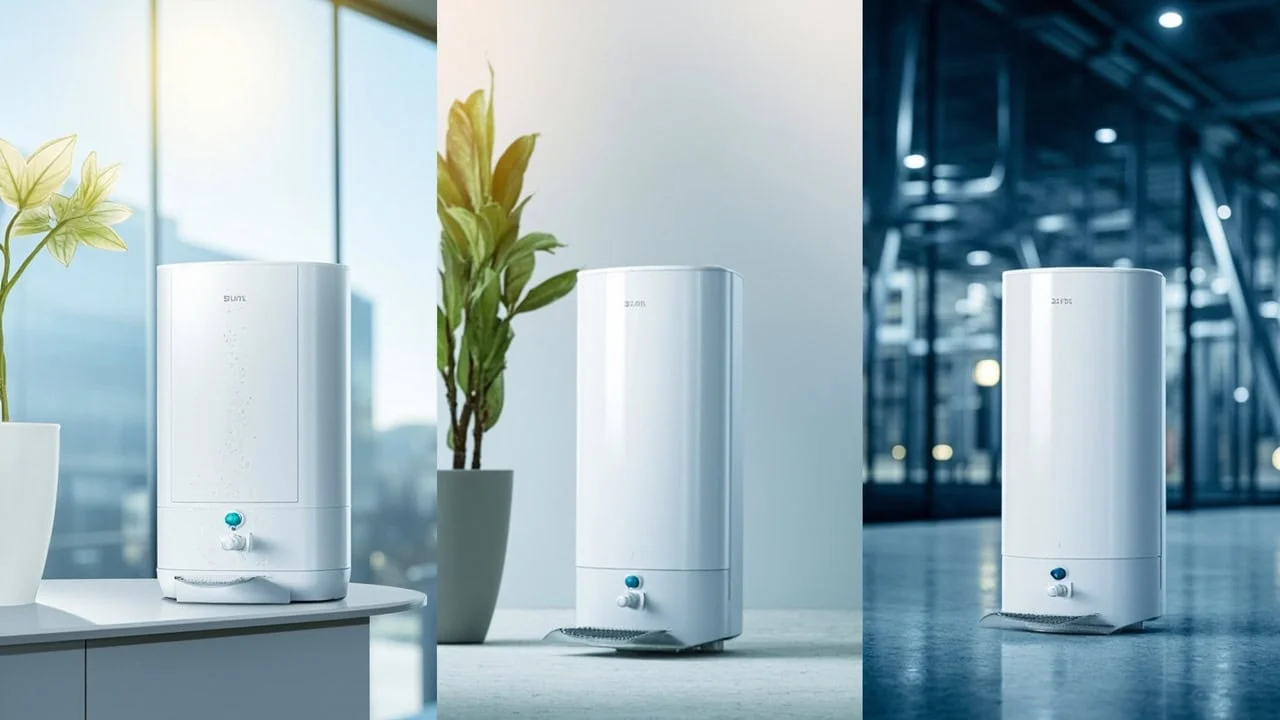
- Production: a 1,000 L/day unit (Zenius A1000-class) covers a 100-room property in mixed climates; arid sites pair the A2000 with a buffer tank. Modular deployments stack multiple units for N+1 redundancy — one unit can service while another runs.
- Storage: a 500–1,000 L potable buffer tank absorbs the breakfast/dinner demand spikes so compressors run steady-state overnight (see the sizing logic in our how atmospheric water generators work).
- Dispensing: three hospitality-grade options — chilled still/sparkling stations at buffets and banquet halls, glass-bottle filling stations for in-room placement, and plumbed water-coolers for back-of-house.
- Brand layer (optional): on-site filling of branded glass bottles turns a cost center into a guest-facing sustainability story — increasingly the deciding factor for corporate-event RFPs.
3. The Financial Case
Cost side (100-room resort, mixed coastal climate)
| Item | Cost |
|---|---|
| Zenius A1000 (1,000 L/day) installed | $28,000–38,000 |
| Buffer tank + piping + dispensing stations | $8,000–15,000 |
| Energy (@ 0.3 kWh/L, $0.15/kWh) | ≈ $16,000/year |
| Filters & service | ≈ $2,500/year |
Savings side
- Bottled-water spend eliminated: $80,000–200,000/year depending on market.
- Logistics and storage freed: no delivery scheduling, no storeroom occupied by pallets, no empty-bottle waste handling.
- Plastic-waste compliance: single-use plastic bans are already law in islands and coastal provinces across 30+ countries — AWG is the compliance path, not just the cost path.
Typical payback: 12–24 months for properties in high bottled-water-cost markets; under 36 months almost everywhere else. The full per-litre comparison against bottled supply is in our atmospheric water generator cost per litre.
4. What Guests Actually Experience
- Taste: mineralized, chilled still and sparkling water at buffet stations — served in glass with the hotel’s branding. Guests notice; sustainability managers notice more.
- Trust: every drop passes UV and multi-stage filtration on-site (see is atmospheric water safe to drink?) — a stronger story than “bottled somewhere unknown.”
- Reliability: water production is independent of municipal supply quality and delivery disruptions — a resilience feature properties in water-stressed regions increasingly market explicitly.
5. Implementation Roadmap
- Month 0 — Site audit: 12-month climate data, available plant room space, power capacity, existing dispensing layout.
- Month 1 — Design & pilot: derated production calculation, buffer sizing, one pilot station (usually the main buffet) to validate taste and throughput.
- Month 2–3 — Install & commission: unit installation, tank, piping, station rollout, staff training (see the service schedule in our maintenance guide).
- Quarter 2 — Full rollout: in-room glass-bottle program launch, marketing assets, plastic-reduction reporting for ESG disclosures.
6. FAQ
What happens in low-humidity season?
Derated production plus buffer storage covers seasonal dips; in arid regions we oversize by 1.5–2× or specify hybrid designs. The Gulf deployment case in our Gulf water-security analysis shows the seasonal math.
Can the water be carbonated and chilled?
Yes — dispensing stations include chilled still/sparkling configurations, the same equipment category five-star properties already use, now fed by on-site production instead of delivered bottles.
How much space does the system need?
A 1,000 L/day unit fits in roughly 2–4 m² of plant room with standard ventilation; tanks add 1–2 m². No rooftop array or civil works required unless pairing with solar.
Can we brand the water program?
The equipment is unbranded/white-label by default — most properties launch the program under their own name. For hotels wishing to co-brand the technology story, Zenius supports OEM/ODM branding; see our supplier evaluation guide.
See Also
– AWG sizing guide
– AWG cost per litre analysis
– Hotels & Resorts industry page
– Request a hotel water-cost audit
Hotel Water Supply Comparison: AWG vs Bottled vs Refill
For hotels and resorts, compare three water supply models on cost, sustainability, and guest experience:
| Factor | AWG System | Bottled Delivery | Refill Stations |
|---|---|---|---|
| Annual cost (100-room) | $8K-$12K (electricity + maint) | $30K-$60K (delivery) | $5K-$10K + dispensing |
| Bottles eliminated/yr | 80K-150K | 0 (uses bottles) | 100K+ (BYOB) |
| Guest experience | On-demand, fresh, infinite | Bottles in room (logistics) | Refill at stations (limited) |
| Branding/story | Unique sustainability story | Generic | Generic |
| Logistics complexity | Low (on-site) | High (delivery schedules) | Medium (staff refill) |
| Energy use | 25-50 kWh/day (hotel-scale) | Embedded (transport) | Low (manual refill) |
| Space required | Equipment room 5-10 sqm | Storage for cases | Bottle + refill station |
| Payback period | 18-30 months | N/A (ongoing cost) | 12-24 months |
See it in the field: a Dubai resort and other installs in our AWG case studies.