Hangzhou Zenius New Energy Co., Ltd.
-
+86 158-8822-2598


How to Size an Atmospheric Water Generator: A 5-Step Framework for Home, Office, Hotel & Industrial Buyers (2026)
TL;DR: Size an atmospheric water generator by daily demand (2-3 L/person WHO minimum) × climate factor (30-65% rated output in arid vs humid). Add 20-30% buffer for heatwaves. Zenius recommends A40 for 4-person home, A1000 for 500-student school, A2000 for 200-room hotel.
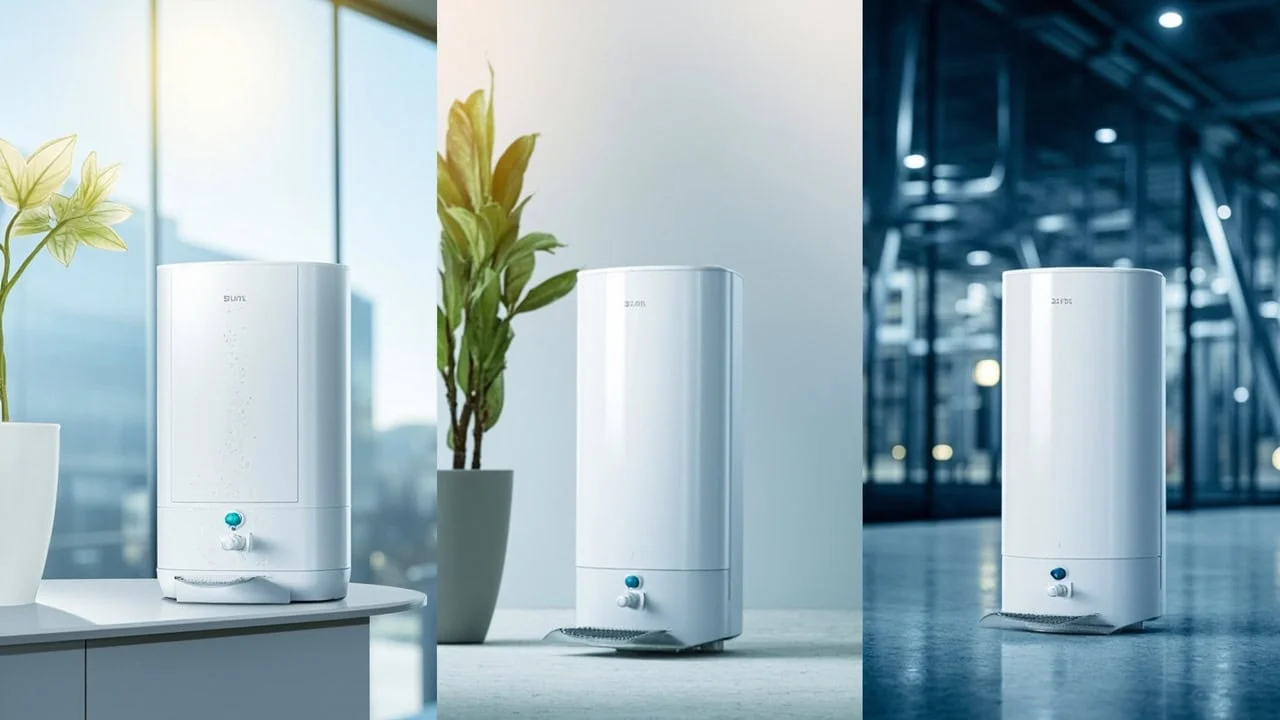
If you’re evaluating atmospheric water generators (AWGs) for a home, an office, a hotel, or a factory, the first spec sheet you’ll be staring at is liters per day — and the second thing you’ll be staring at is the realization that the wrong size either wastes thousands of dollars on electricity or leaves your staff and guests with empty glasses. This guide is the decision framework we use with every Zenius buyer, distilled into five steps and one cheat sheet.
We’ve published every Zenius AWG spec sheet against these same five steps, so once you finish this article you’ll know exactly which model shortlist to ask us about. If you’re new to the technology, start with our what is an atmospheric water generator? primer and our atmospheric water generator cost per litre — sizing and cost are the two pillars of any AWG purchasing decision.
1. The Sizing Problem in One Paragraph
AWG capacity is rated at a reference climate of 30 °C and 80% relative humidity. Move the unit to a real-world site — Riyadh at 25% RH, or Manchester at 65% RH — and output drops to 30–65% of the rated number. So the literal “rated L/day” on the spec sheet is not what you’ll actually get, and a buyer who sizes to the rated number ends up short on water.
The reverse mistake — sizing for “more than I need” — wastes money on the equipment itself and on the compressor electricity to run a larger unit at low duty cycle. So the framework below is built around one number: your true daily demand in litres, in your climate, with a realistic buffer. Everything else flows from there.
2. Step 1 — Calculate Your Daily Water Demand
The starting point is always demand, never equipment capacity. Three numbers matter:
- Daily drinking water per person: 2–3 L/day per person is the WHO drinking-water guideline benchmark for basic hydration, matching U.S. CDC recommendations. Add 1–2 L/day per person for cooking, and you’re at 3–5 L/day per person for residential.
- Daily non-drinking use per person (washing, cleaning, toilets): in most AWG deployments, AWG output is not used for non-drinking purposes unless the buyer is in an arid off-grid site. For the framework here, we focus on drinking + cooking only, which is what most AWG buyers actually use.
- Visitor / guest / shift worker load: offices add visitors and meeting room water; hotels add per-room guests and F&B service; schools add student turnover; factories add shift workers.
The basic formula is:
Daily demand (L/day) = (residents × 4 L) + (visitors × 2 L) + (process water, if any)
Worked example for a family of 4 in Dubai: 4 × 4 = 16 L/day. With guests on weekends, round up to 20 L/day. That’s the input to Step 2.
If you skip this step and just pick a model, you’ll either overspend or run dry within six months — the two most common AWG buyer’s remorse stories we hear.
3. Step 2 — Match Capacity to Facility Type
Once you have a demand number in litres per day, the facility type drives the equipment class. The Zenius product line breaks into four buckets; here’s how each maps to demand.
| Facility type | Typical demand | Zenius equipment class | Representative models |
|---|---|---|---|
| 1–2 person household / studio | 5–15 L/day | Portable / countertop | A12 (12 L), G3 Home (30 L for a couple with guests) |
| 3–5 person family / home office | 15–40 L/day | Residential household | A20, A20 Home, A40 |
| Villa / small office / small hotel | 40–80 L/day | Villa-grade | A70 (70 L) |
| Boutique hotel, school, small factory | 80–250 L/day | Small commercial | A100 (100 L), A250 (250 L) |
| Mid-size hotel, resort, large school, factory | 250–1000 L/day | Commercial | A500 (500 L), A1000 (1000 L) |
| Industrial, large resort, military, off-grid village | 1000+ L/day | Industrial | A2000 (2000 L), A5000 (5000 L), A10000 (10000 L), ZEN-L 6000 (6000 L) |
| Mobile / vehicle / off-grid | varies | Mobile | VM Vehicle-Mounted, Mobile Vehicle-Mounted, MWT Multi-Stage |
Worked example continued for our family of 4 in Dubai: 20 L/day demand maps to the residential household class. The A40 (40 L/day) is the right-sized unit, not the A20 (too small when humidity drops) and not the A70 (over-spec’d for a family of 4).
If you’re comparing multiple models, our complete product catalogue lists every spec including compressor power draw, dimensions, and noise level — three specs that matter almost as much as the L/day rating once the unit is installed.
4. Step 3 — Adjust for Climate and Humidity
Rated capacity assumes 80% RH at 30 °C. Real-world climate takes a big bite out of that number. The rule of thumb from our deployment data:
- 80–90% RH (tropical coast, e.g. Singapore, Manila): 90–100% of rated output.
- 60–80% RH (most of Europe, US east coast, southeast China): 65–85% of rated output.
- 40–60% RH (Dubai coastal, Mediterranean summer): 45–65% of rated output.
- 20–40% RH (Riyadh inland, Death Valley, Atacama): 25–45% of rated output.
The implication: a buyer in Riyadh needs to size 2× to 3× the demand number, while a buyer in Manila can size to 1× demand.
Worked example continued for our family of 4 in Dubai (coastal, ~55% RH typical): demand 20 L/day × 1.6 climate factor (mid-arid) = 32 L/day true required output. The A40 handles this comfortably, with margin. If the same family were relocating to Riyadh inland, they’d need to size to an A70 or larger.
Climate is also why our buyers in arid regions often run their AWGs in pairs or add a buffer tank — see Step 4. Our field data from the NEOM megaproject region and the Gulf countries water-security initiative shows that arid-zone buyers consistently over-size by 1.5–2× to handle summer humidity drops and dust-load filter changes. The 2025 Nobel Prize in Chemistry for metal-organic frameworks hints at future capacity gains in arid climates, but as of 2026 the conservative sizing rule above still applies.
5. Step 4 — Add Buffer, Peak Hours, and Redundancy
A perfect-sized unit running at 100% duty cycle 24/7 has zero margin for: a heatwave, a power outage, a maintenance day, or a sudden meeting with 30 visitors in the boardroom. Real-world buyers always add buffer. Three patterns are common:
20–30% buffer for steady-state demand. A 40 L/day unit feeding a 30 L/day demand has 33% buffer — enough to absorb a hot week, a missed filter change, or one compressor service day per quarter. This is the most common sizing for offices, villas, and small hotels.
Redundant parallel units for mission-critical sites. Hospitals, military bases, off-grid villages, and large hotels often run two or more units at half-rated output each. The advantage is zero-downtime serviceability (one unit down for maintenance, the other carries full load) and load-balancing during peaks (both at full output during morning and evening draw).
Buffer tank for peak shaving. A 200–500 L storage tank between the AWG and the dispense point lets the compressor run at steady state overnight (when humidity is highest) and lets users draw heavily during the morning peak. This is the standard pattern for schools (kids fill bottles at 7:30 a.m.) and shift-based factories (workers arrive in waves).
For an export buyer running AWGs at scale, our How to Import Atmospheric Water Generators from China guide covers the OEM/ODM considerations that affect which models you source for the buffer-tank and parallel-unit patterns.
6. Step 5 — Cross-Check Against Your Electricity Budget
Once you have a sized unit, run it through the electricity math. The full methodology is in our AWG cost per litre analysis — the headline number is that electricity is 60–80% of the per-litre cost, so a 2× larger unit running at low duty cycle usually costs less per litre than a right-sized unit running flat-out, because compressor cycling efficiency improves.
Rule of thumb: monthly electricity = unit L/day × climate factor × 0.6 kWh/L × $/kWh × 30. For our Dubai family of 4 with an A40: 40 × 0.6 (climate) × 0.6 kWh × $0.082 (UAE residential) × 30 = $35/month in electricity. Total water cost including amortization and filter changes lands around $0.03–$0.05/L — see the cost per litre of atmospheric water for the math.
If the electricity budget is a constraint, the right move is often to right-size for climate, not for rated demand — an A40 in humid Manila outperforms an A70 in dry Madrid on litres delivered per kWh spent.
7. Sizing Cheat Sheet
Here’s the quick-reference table for the most common Zenius buyer scenarios. Use it as a starting point for your spec sheet.
| Scenario | Demand (L/day) | Climate | Recommended model | Buffer |
|---|---|---|---|---|
| Single adult, humid | 5 | Tropical | A12 | Tight |
| Single adult, arid | 8 | Arid | A20 | 2× climate |
| Couple, no kids | 12 | Mixed | A20 Home | 1.5× climate |
| Family of 4 | 20 | Mixed | A40 | 1.5× climate |
| Family of 4, arid | 25 | Arid | A70 | 1.2× climate |
| Villa, 8–10 guests/day | 40 | Mixed | A70 | 1.5× climate |
| Boutique hotel, 20 rooms | 100 | Mixed | A100 | 1.3× climate |
| Mid-size hotel, 80 rooms | 300 | Mixed | A500 | 1.4× climate |
| School, 500 students | 250 | Mixed | A250 + buffer tank | 1.3× climate |
| Resort, 200 rooms + F&B | 600 | Mixed | A1000 | 1.4× climate |
| Factory, 200 shift workers | 800 | Arid | A1000 | 1.6× climate |
| Industrial village | 3000 | Arid | A5000 + parallel unit | 1.6× climate |
| Off-grid military base | 5000 | Arid | A10000 | 1.6× climate |
For buyers evaluating AWG against alternative technologies, our AWG vs bottled water analysis and AWG explained round out the decision tree. Buyers in arid regions should also read our breakthrough-in-air-to-water-technology coverage — arid-climate output has improved materially since 2024.
8. FAQ
Q: How many liters per day do I need for a family of 4? A: 16–25 L/day in mixed climates, 25–35 L/day in arid climates. The A40 (40 L/day) covers family-of-4 demand in both climates with buffer.
Q: Can one AWG handle a hotel with 100 rooms? A: At 5 L per room per day for in-room bottled water replacement and 200 L/day for F&B and back-of-house, plan on 700–900 L/day. The A1000 (1000 L/day) handles 100-room hotels in mixed climates; arid sites need the A2000 (2000 L/day) plus a buffer tank for morning peak.
Q: What happens if humidity is below 30%? A: Output drops to 25–45% of rated capacity. Solutions: (a) over-size by 2×, (b) add a buffer tank, (c) run parallel units. Arid-climate buyers should also budget for more frequent filter changes because of dust loading.
Q: Do I need a buffer tank? A: For residential use, typically no — the AWG’s internal tank covers morning draw. For commercial use (schools, hotels, factories) where demand is bursty, a 200–500 L buffer tank lets the compressor run at steady-state overnight and absorbs morning peaks.
Q: What’s the smallest AWG for an office of 20 people? A: 40–60 L/day in mixed climate, 60–100 L/day in arid. The A70 (70 L/day) is the smallest practical unit for a 20-person office. Smaller units can’t keep up with office meeting-room water usage.
Conclusion
Sizing an atmospheric water generator is a five-step exercise in matching demand to climate to equipment to budget. Skip any of those steps and you’ll either run dry or run expensively. The framework above is the same one we use with every Zenius deployment — residential, commercial, and industrial — and the cheat sheet in §7 covers the 13 most common buyer scenarios.
If your scenario isn’t on the cheat sheet, or your climate or facility has unusual constraints, contact our sizing team — we run a free 30-minute sizing review for buyers evaluating AWGs at 100 L/day or above.
See also: other Zenius guides by use case
For K-12 schools and universities, the sizing framework above applies with additional child-safety, compliance, and procurement considerations covered in our AWG for schools guide. For buyers comparing atmospheric water generation against off-grid alternatives like rainwater harvesting, our AWG vs rainwater harvesting comparison covers the climate-fit, water-quality, and 10-year cost trade-offs. And for cost-per-litre breakdown by model, climate, and electricity rate, see our atmospheric water generator running cost.
Q: What if my facility needs 24/7 production? A: For continuous operation, size up to 1.5× normal demand and add redundancy. Most commercial AWGs are designed for continuous duty; pair with a buffer tank sized for 4–8 hours of normal demand. For mission-critical deployments (hospitals, data centers, off-grid communities), consider N+1 redundancy with two units at 60% capacity each — if one fails for service, the other carries full load.
Q: How do I account for seasonal humidity variations? A: In monsoon climates (Singapore, Mumbai, Hong Kong), humidity varies 60–90% across the year. Size for the worst 25th percentile (75% of days at the lower humidity). In Mediterranean climates (LA, Athens, Perth), humidity drops 30–50% in summer; size for the worst month. Tropical humid climates see 75–85% RH year-round, so rated output is more reliable. Zenius publishes climate-specific derate tables for each region on request.
Browse the full Zenius AWG catalogue for spec sheets, or revisit our atmospheric water generator cost per litre for the electricity-budget math.
See also: related Zenius resources
- UAE deployment guide
- Saudi Arabia deployment guide
- Hotels & Resorts industry guide
- Schools & Universities industry guide
- Contact Zenius team
- Qatar deployment guide
- Bahrain deployment guide
- Kuwait deployment guide
- Oman deployment guide
- Dubai deployment guide
AWG Capacity by Model and Climate
Compare real output across 4 Zenius models and 3 climate zones:
| Model | Tropical (rated) | Mediterranean (80%) | Arid (50%) |
|---|---|---|---|
| A12 (12 L/day rated) | 12 L | 10 L | 6 L |
| A40 (40 L/day rated) | 40 L | 32 L | 20 L |
| A1000 (1000 L/day rated) | 1000 L | 800 L | 500 L |
| A10000 (10000 L/day rated) | 10000 L | 8000 L | 5000 L |
Next step: once you know your capacity class, compare concrete picks in our best atmospheric water generators by use case (2026) guide.
Browse models: once you know your target, compare all units in the AWG product centre.

